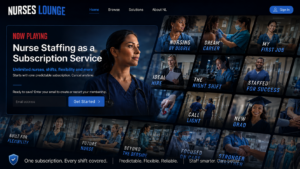
Hospitals spend more than $51 billion a year on contract labor. Total hospital workforce spending topped $1 trillion in 2025, with labor now eating up roughly 60 cents of every operating dollar. Those aren’t crisis-year numbers. That’s the new baseline and it’s time for change. Subscription staffing for nurses is finally here.
Every CFO in the country has looked at that agency line item and asked the same question: why are we paying premium rates for labor we don’t control, can’t forecast, and don’t own the relationship with? It’s not a new complaint. Finance leaders have been raising it in budget meetings for years. What’s been missing isn’t the diagnosis — it’s a real alternative to point to, and the technology to make that alternative work.
The Math Doesn’t Work, and Everyone Knows It
The per-placement agency model has a structural flaw baked into its incentives. The agency gets paid when a shift gets filled — not when a hospital builds a stable, cost-predictable workforce. Those two goals aren’t aligned.
That tension shows up in three places every finance leader recognizes. Cost volatility: agency and travel rates move with demand shocks the hospital doesn’t control, but the budget doesn’t flex with them. No equity in the relationship: every dollar spent on a per-shift placement buys one shift, with no continuity of care and no reduction in future spend. And an incentive gap: a staffing agency’s ideal outcome is a hospital that stays dependent; a hospital’s ideal outcome is a workforce it doesn’t need to rent. The same contract can’t maximize both.
None of this is controversial. It’s just been the only option — until recently.
What Happens When Subscription Staffing Replaces Transaction
This isn’t the first industry to hit this exact wall. Software used to be sold per license, per install, with margins that rewarded friction and lock-in. Subscription pricing flipped the incentive: the vendor only wins if the customer keeps getting value, month over month. Media did the same — buying a movie or album per-unit gave way to flat monthly access (Netflix & Spotify), and the companies that made the shift captured most of their category. Transportation followed the pattern too, trading per-ride fares for predictable ride sharing technology.
In every case, a per-transaction incumbent got disrupted not by a better version of the same transaction, but by a different pricing structure that removed the volatility and realigned incentives around the customer’s actual goal, not the vendor’s next invoice.
Nurse staffing has never had that moment — because until now, it lacked the one thing every one of those industries needed first: the technology to match supply and demand precisely enough to make a flat-fee model financially sound. It’s time for subscription staffing to enter the ring.
The Technology Is What Makes the Timing Right
Subscription pricing only works when the provider can predict and manage demand well enough to price it flat and still make the math work. Netflix needed streaming infrastructure. Uber needed real-time GPS and routing. Nurse staffing needed something equivalent: a way to see supply and demand across an entire market in real time, and match the two automatically instead of manually.
That capability exists now. AI-driven matching can read credentials, availability, location, and facility needs simultaneously, and route nurses to open shifts the way modern platforms route a driver or a delivery — instantly, and at a scale no human staffing coordinator could manage. That’s the missing piece that makes flat-fee nurse staffing viable instead of theoretical. It’s also why this shift is happening now, not five years ago: the technology finally caught up to the pricing model it needed to support.
Nurse FLEX Pool is one working example of this — an AI-supported platform built to give hospitals predictable, flat-fee access to a nursing pipeline instead of a per-shift bidding war. It’s not the only way this could be built. But it’s evidence the model works outside a whiteboard, and that the technology behind it is functioning today, not in some future roadmap.
The Question for the CFO Reading This
What would your budget look like if agency and contract labor spend were a single, flat, predictable monthly line item — instead of a number that swings with every regional shortage and every competitor’s recruiting push?
For most CFOs, the honest answer is that nobody’s modeled it, because until recently, there was nothing real to model it against. That’s changing.
“What would your budget look like if agency and contract labor spend were a single, flat, predictable monthly line item — instead of a number that swings with every regional shortage and every competitor’s recruiting push?”
You can find out how it would save your organization in a few minutes at the Nurse Staffing Cost Calculator. When you see those numbers, you’ll want to learn more, and that’s easy too.