
Per Diem Nurse Staffing Texas for Facilities
Nurse FLEX Pool is a subscription-based nurse staffing Texas access model from Nurses Lounge that helps Nurse Staffing Texas healthcare facilities post PRN and per diem shifts to a local nurse pool through an on-demand platform and mobile app, without hourly mark-up fees.
If you are trying to cover recurring PRN and per diem shifts across one facility or multiple Texas markets, the pressure usually shows up in the same two places: labor costs stay hard to predict, and your team still does not have a repeatable coverage process. That challenge is harder in Texas, where staffing conditions vary by market, commute radius, and facility type. Nurse FLEX Pool gives your team a more direct way to reach local nurses and build a more repeatable coverage model over time.
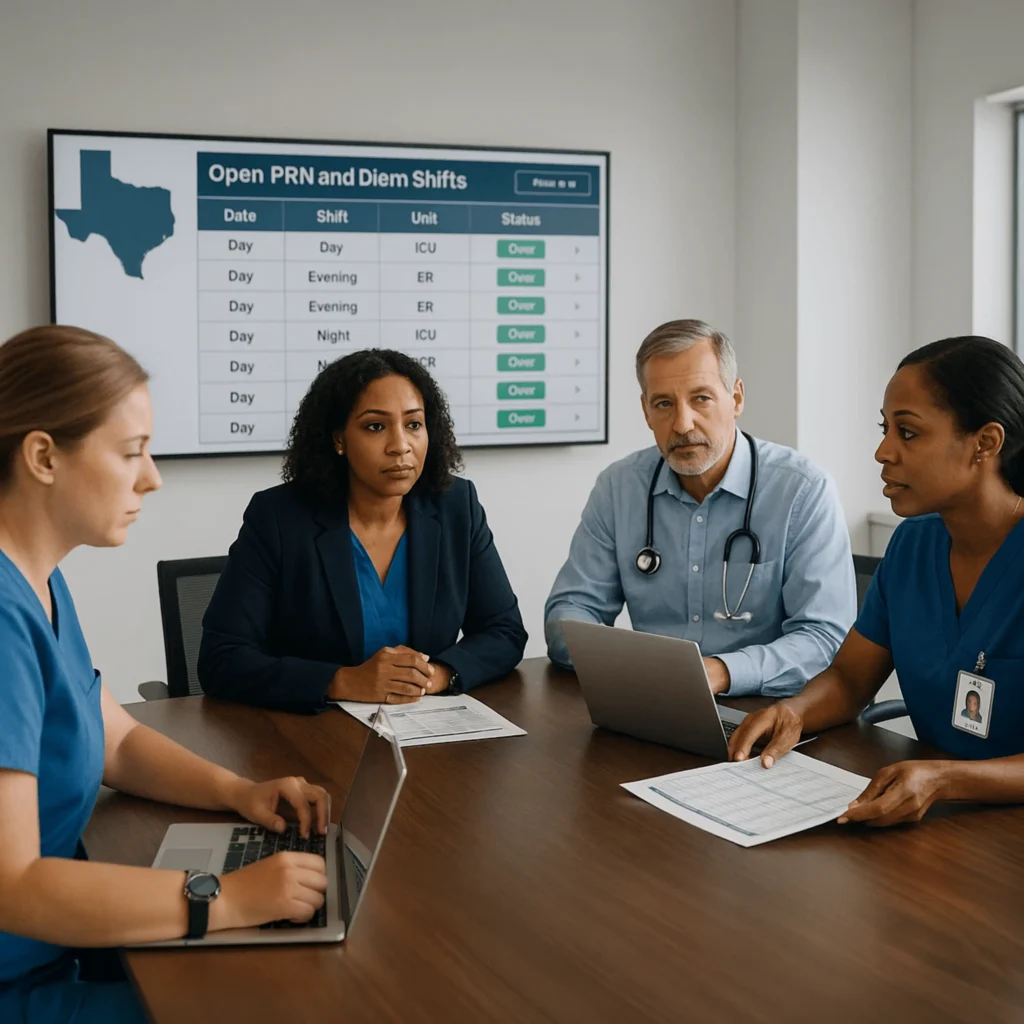
Why this issue is especially difficult in Texas
Texas facilities are managing nurse staffing pressure in a market with persistent workforce constraints and uneven local supply. The Texas Hospital Association reports that more than 60% of Texas hospitals were operating with fewer beds and reduced services due to lack of staff in 2023. The association also projects that Texas could face a shortage of more than 57,000 full-time registered nurses by 2032.
That matters because recurring PRN and per diem gaps are not just isolated scheduling issues. In Texas, they often reflect a larger operating reality: rising demand, uneven local coverage, and limited visibility into a repeatable staffing model.
What does the staffing decision come down to in Texas?
For most healthcare facilities in Texas, the question is not whether you need contingent staffing. The question is which staffing model gives you enough flexibility without pushing you deeper into cost volatility, rushed approvals, and repeated last-minute decisions.
That decision gets harder in a state where staffing conditions do not look the same from one market to the next. A system managing coverage in Dallas-Fort Worth may be dealing with dense competition and multi-campus staffing complexity. A facility in Houston may be working within a different commuter footprint and labor pattern. Teams in Austin, San Antonio, West Texas, or smaller surrounding markets may face different access constraints altogether.
The common issue is not geography by itself. It is the lack of a repeatable local coverage model when recurring demand keeps returning.
How Texas facilities usually choose a coverage model
The right path depends on what is creating the most pressure right now: urgent coverage gaps, limited internal staffing infrastructure, or recurring agency dependence.
Use agencies when the gap is immediate
Agency staffing can still be the fastest short-term answer when a unit has an urgent opening and no internal structure is ready to respond. In Texas, that may be the practical choice when a shift must be filled immediately and the local pipeline around that facility is not already organized. The tradeoff is higher variable cost, less continuity, and less control over how contingent staffing scales over time.
Use an internal Float Pool when it is already built
An internal Float Pool can work well when your organization already has the recruiting depth, scheduling discipline, and management capacity to run it consistently. That is often easier for larger systems with mature internal infrastructure. If that structure is thin, especially across multiple campuses or service areas, the model can require more coordination than teams expect.
Use Nurse FLEX Pool when the problem is recurring
Nurse FLEX Pool is built for recurring PRN and per diem coverage. It gives your team a repeatable way to post shifts and reach local nurses through a subscription-based model without defaulting to agency markups every time demand spikes. That can be especially valuable in Texas, where staffing conditions are local even when leadership oversight is regional or statewide.
Open shifts create cost pressure and decision pressure
The external problem is rising contingent labor pressure in a state with persistent nurse workforce constraints.
The internal problem is that your team still has to explain why labor costs remain hard to control even when the same shift gaps keep repeating. The broader issue is that hospitals should not have to rely on a middleman to reach nurses who already live and work in their communities.
In Texas, that pressure can build quickly when coverage decisions are being made across different units, campuses, or service areas. Agency markups can rise faster than staffing stabilizes, and overtime becomes the fallback when a shift is too urgent to leave open.
The result is a familiar pattern: recurring staffing gaps, limited budget visibility, premium-rate decisions, and no clear path away from the cycle.
A more direct way to build repeatable local coverage
Nurse FLEX Pool gives your facility a flat monthly subscription fee and unlimited access to a local Float Pool through an on-demand staffing platform and mobile app workflow. Your team posts open PRN and per diem shifts, reviews nurses, and builds a more repeatable process over time instead of restarting the search with every staffing gap.
That matters in Texas because staffing decisions are local even when oversight is not. A system may be managing labor pressure across Dallas-Fort Worth, Houston, Austin, San Antonio, or smaller surrounding markets, but each open shift still has to be filled near the facility that needs coverage. In a large state, local access is not a vague promise. It is a practical staffing requirement.
Nurse FLEX Pool is not a staffing agency. Nurses Lounge does not charge healthcare facilities hourly mark-up fees for access to the platform.
Your team still controls who you approve, how you staff shifts, and how you use contingent coverage inside your broader workforce strategy.
- Your team posts PRN and per diem shifts through the platform.
- Local nurses can view and apply through the mobile app workflow.
- Your facility reviews credentials and resumes, then approves the nurses you want to work.
- Over time, your team can build a more usable local pool for recurring coverage instead of treating every opening like a new search.
Which staffing model fits the pressure you are under?
No staffing model wins in every situation. In Texas, the better question is which tradeoffs fit your cost structure, internal capacity, and repeat coverage needs at the facility level.
| Decision factor | Agency staffing Fastest external option for urgent gaps | Internal float pool Strong when the structure already exists | Nurse FLEX Pool Subscription-based local nurse access |
|---|---|---|---|
| Best fit | Immediate urgent coverage | Organizations with mature internal staffing structure | Recurring PRN and per diem coverage |
| Cost structure | Hourly markups | Internal labor and management overhead | Flat monthly subscription fee |
| Speed to start | Often fastest | Fast if already built | Requires setup and adoption |
| Budget predictability | Lower predictability | Moderate to high | Higher fee predictability |
| Workflow control | Less direct control | Highest internal control | More direct facility control |
| Fit for recurring weekly shifts | Can become expensive | Can work if staffed well | Built for repeat access |
Why Texas staffing coverage is harder to standardize
Texas is not one staffing market. A facility in Dallas-Fort Worth may be working through one labor pattern, a Houston facility another, and a rural hospital or smaller surrounding market another altogether. The pressure may look similar on paper, recurring PRN shifts, agency dependence, and overtime fatigue, but the local nurse pool around each facility is what determines how practical a staffing model really is.
That is one reason statewide planning often breaks down at the facility level. A centralized staffing strategy still has to help individual facilities reach nurses within a realistic distance of the building that needs coverage. If that local connection is weak, the same gaps keep cycling back through overtime and agency channels.
The issue is even more visible in rural Texas and smaller markets, where some communities are far from the next nearest hospital and backup options are limited. In those settings, a repeatable local access model matters even more because the margin for last-minute staffing decisions is smaller.
What local nurse access means for Texas facilities
For a Texas healthcare facility, local nurse access is not a vague brand promise. It means giving your team a more direct way to reach nurses in the area around the facility that needs coverage, instead of treating shift fulfillment like a broad statewide search or another agency request.
In Texas, that matters because commute practicality shapes staffing decisions. A nurse who is willing to pick up shifts near one part of the Metroplex may not be willing to cross the region for a last-minute opening. In smaller Texas communities, the issue can be even more practical: the available local pool is smaller, so repeatable access matters more.
Nurse FLEX Pool is built around that local access model. Your team posts shifts, reviews nurses, and builds a more repeatable workflow around recurring needs without paying hourly mark-up fees to a staffing middleman.

Why the staffing pressure keeps returning in Texas
Texas facilities are not dealing with a short-term staffing issue alone. They are also dealing with a longer workforce pipeline problem. The Texas Hospital Association reports that Texas nursing schools turned away 13,705 qualified applications in 2023 because of faculty and clinical space constraints.
That matters because recurring PRN and per diem gaps do not reopen only because of poor scheduling. They reopen because demand keeps rising, local supply remains uneven, and the pipeline of new nurses has not expanded fast enough to relieve pressure across every market.
Built on a broader nursing marketplace
Nurses Lounge connects nurses, students, schools, healthcare employers, and industry partners on one professional network. That broader marketplace matters in Texas, where facilities often need stronger visibility with nurses in and around the communities they serve. Nurse FLEX Pool sits within a nurse-first platform built to aggregate and connect the nursing profession.
Common questions from per diem nurse staffing Texas healthcare facilities
How does per diem nurse staffing in Texas work without relying only on agencies?
Per diem nurse staffing in Texas works by helping facilities fill short-term or recurring shifts with qualified nurses who are available for PRN coverage. Facilities can do that through agencies, internal Float Pools, or direct-access staffing models, depending on how often the need occurs and how much control the facility wants to keep. Nurse FLEX Pool supports a more direct model by giving facilities one workflow to post shifts, review nurses, and build repeatable local access without hourly mark-up fees.
Why is staffing harder to standardize across Texas?
Staffing is harder to standardize across Texas because the state is made up of very different labor markets. Conditions in Dallas-Fort Worth, Houston, Austin, San Antonio, rural Texas, and smaller surrounding communities can vary significantly in terms of nurse availability, commute patterns, and facility density. That is why many facilities need a more local coverage model rather than a single statewide staffing approach.
Why does local nurse access matter in a large state like Texas?
Local nurse access matters in Texas because staffing decisions depend on who can realistically work near the facility that needs coverage. In a large state, a broad statewide nurse pool is not the same thing as practical local availability for recurring PRN and per diem shifts. For recurring PRN and per diem coverage, practical local availability often matters more than the size of the total statewide pool.
Does Texas being a Nurse Licensure Compact state solve the staffing problem?
No, Texas being a Nurse Licensure Compact state does not solve the staffing problem by itself. Compact participation can support nurse mobility across participating states, but facilities still need a practical way to reach, review, and approve nurses for recurring local coverage needs. Nurse FLEX Pool helps facilities manage that local access through a subscription-based platform workflow.
How is Nurse FLEX Pool different from a traditional staffing agency?
Nurse FLEX Pool is different from a traditional staffing agency because it is a subscription-based staffing access model, not an hourly mark-up model. Traditional agencies typically charge variable per-shift or hourly fees, while Nurse FLEX Pool gives facilities flat-fee access to post PRN and per diem shifts, review nurses, and manage approvals through the platform. That gives facilities more direct control over recurring coverage workflows.
When does Nurse FLEX Pool make the most sense for a Texas facility?
Nurse FLEX Pool makes the most sense when a Texas facility is dealing with recurring PRN and per diem coverage needs rather than occasional one-off emergencies. It is especially relevant when teams want more budget predictability and a more repeatable process than repeated agency use. In those situations, Nurse FLEX Pool gives facilities a direct way to reach local nurses through a subscription-based model.
Is Nurse FLEX Pool a fit for rural or smaller Texas markets?
Yes, Nurse FLEX Pool can be a fit for rural or smaller Texas markets when a facility has recurring PRN or per diem coverage needs and limited backup options. In those settings, backup options are often more limited and distance matters more, which makes practical local coverage especially important. Nurse FLEX Pool can support that need, depending on the facility’s coverage volume, workflow, and staffing goals.
Is Nurse FLEX Pool the right fit for every Texas facility?
No, Nurse FLEX Pool is not necessarily the right fit for every Texas facility. Facilities with a strong existing internal process for recurring PRN and per diem coverage may need less external support, while others may need more local nurse access, budget predictability, or workflow structure. Nurse FLEX Pool is best suited for facilities that want a more direct and repeatable model than relying only on overtime or staffing agencies.
What can a Texas healthcare facility use instead of agency staffing?
A Texas healthcare facility can use an internal Float Pool, a direct-access staffing platform, or a blended staffing model instead of relying only on agency staffing. The best option depends on whether the main problem is urgent fill speed, recurring coverage pressure, internal staffing capacity, or budget predictability. Nurse FLEX Pool is designed for facilities that need a more repeatable local access model for recurring PRN and per diem shifts.
See whether Nurse FLEX Pool fits your Texas nurse staffing shift coverage model
If you are trying to reduce agency dependence, improve budget predictability, and create a more direct workflow for recurring PRN and per diem coverage, request a demo to see how Nurse FLEX Pool fits your facility.