
What Is Per Diem Nurse Staffing for Healthcare Facilities?
Per diem nurse staffing is an as-needed shift coverage model that helps healthcare facilities fill open PRN and per diem shifts without adding full-time headcount for every fluctuation in demand. In practical terms, it means using qualified nurses for specific open shifts caused by call-outs, census changes, weekends, holidays, leave coverage, or recurring unit-level staffing gaps.
Nurse FLEX Pool from Nurses Lounge gives facilities a third option: subscription-based access to a local Float Pool through an on-demand platform and mobile app, without hourly mark-up fees.
filled by the day
Why per diem nurse staffing matters more to healthcare facilities now
Per diem nurse staffing matters because labor pressure has not gone away. Texas hospital leaders continue to deal with vacancy pressure, service expansion, and a workforce pipeline that is still catching up. The Texas Hospital Association says more than 60% of hospitals were operating with fewer beds and reduced services because of staffing shortages, and Texas demand for full-time registered nurses is projected to exceed supply by more than 57,000 by 2032.
In markets such as Fort Worth and the broader DFW region, that pressure is amplified by health system growth. JPS Health Network has broken ground on a major new hospital project, Cook Children’s is expanding its campus, Baylor Scott & White is growing emergency capacity, and Texas Health Harris Methodist Fort Worth is adding projects aimed at relieving emergency department strain. More capacity creates more need for dependable shift coverage.
That is why per diem staffing is not just a definition question. It is an operating model question. If your team is covering the same types of open shifts week after week, the real issue is whether your current staffing process is sustainable.
What per diem nurse staffing means for hospitals and healthcare facilities
Per diem nurse staffing means filling shifts on an as-needed basis rather than relying only on regularly scheduled full-time staff. The term per diem literally means by the day. In healthcare, facilities use the model to cover open shifts tied to call-outs, vacations, leaves, seasonal spikes, weekends, holidays, and unit-level fluctuations in patient demand.
Per diem staffing is often grouped with PRN staffing, contingent staffing, and flexible shift coverage. The exact structure can vary, but the core idea is the same: your facility gets access to nurses who are available to work specific shifts when demand changes.
For facility buyers, this matters because per diem staffing sits between two extremes. It is more flexible than adding permanent staff for every demand spike, and it can be more repeatable and locally targeted than defaulting to agency staffing every time a shift opens.
What healthcare leaders are actually deciding when a shift opens
When a shift opens, the decision sounds simple. Find coverage. But operationally, your team is usually making a larger workforce decision.
Do you absorb the gap through overtime and increase burnout pressure? Do you call an agency and accept another premium-cost shift? Or do you build a more direct, repeatable way to access local nurses for recurring PRN and per diem demand?
That is the real value of understanding per diem nurse staffing correctly. It is not just a category of labor. It is a framework for how your facility manages recurring open-shift coverage.
How per diem staffing usually works in practice
The right staffing path depends on what kind of pressure your facility is trying to solve. Same-day urgency, recurring weekly gaps, seasonal surges, and long-term vacancies are not the same problem.
Use overtime when the gap is occasional and internal staff can absorb it
Overtime can be the fastest internal answer when the gap is limited and your team has capacity. The tradeoff is that if overtime becomes the standard response, labor costs rise and burnout pressure follows.
Use agency staffing when outside coverage is urgent and no direct workflow exists
Agency staffing can still be the practical choice for immediate outside coverage. But agency use often comes with hourly markups, less cost predictability, and a middleman-based workflow that repeats every time demand returns.
Use an internal Float Pool when your organization already has the infrastructure
Some hospitals and health systems run strong internal PRN or Float Pool programs. When the infrastructure, scheduling process, recruiting support, and management discipline are already in place, that can work well.
Use Nurse FLEX Pool when recurring per diem demand keeps returning
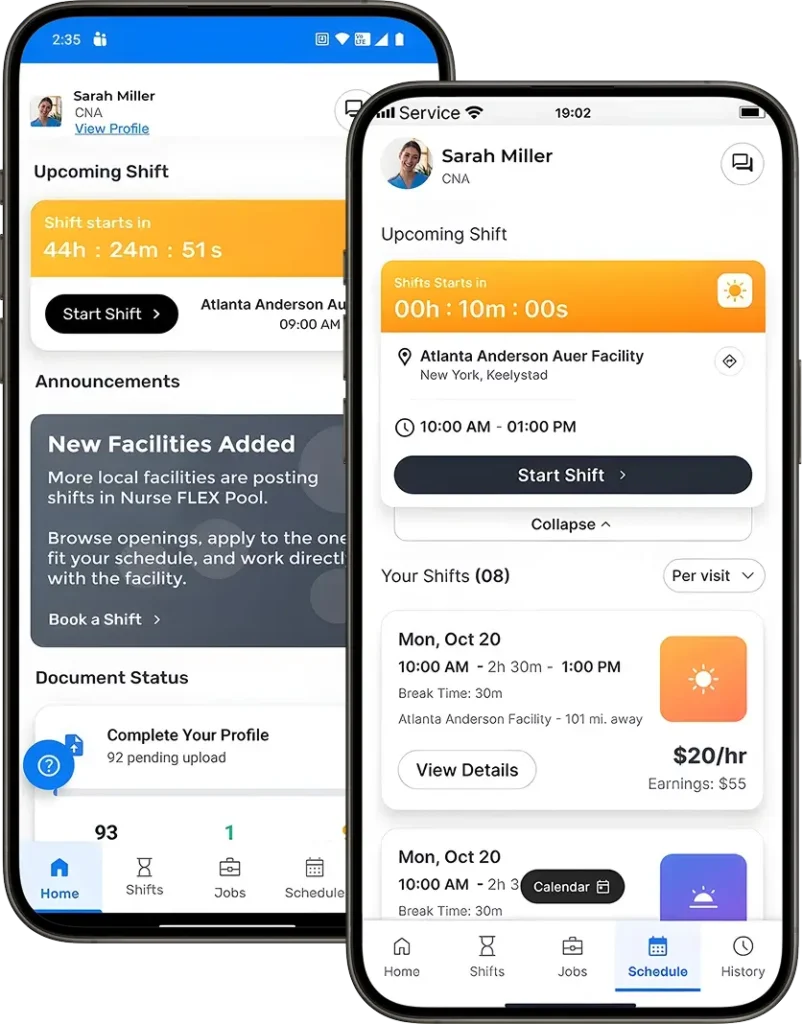
Nurse FLEX Pool is designed for facilities that want a more direct and repeatable way to cover PRN and per diem shifts. Your team posts shifts through the platform, local nurses review openings in the mobile app, and your facility reviews and approves who you want to work, all through a flat monthly subscription fee rather than hourly mark-up fees.
Per diem staffing vs agency staffing, what is the difference?
Per diem staffing and agency staffing can both help fill open shifts, but they are not the same model.
Agency staffing usually means paying a third party to source and place clinicians, often with hourly markups built into each shift. Per diem staffing means using nurses on an as-needed basis for individual shifts. That per diem access can happen through an internal pool, a staffing agency, or a direct-access platform.
For buyers, the important difference is not just who the nurse is. It is how the economics and workflow are structured. If every shift runs through an outside middleman, costs tend to stay variable. If your facility can build more direct access to a local nurse pool, the process becomes more repeatable.
Why per diem staffing gets expensive when the workflow stays reactive
The external problem is simple. Staffing demand changes faster than full-time schedules can absorb. Call-outs, unit fluctuations, weekends, holidays, leaves, and census spikes keep creating open shifts.
The internal problem is that your team still has to explain labor cost decisions that feel temporary but keep repeating. A single shift may look manageable. A recurring pattern of premium overtime and agency use becomes a budgeting problem.
The broader problem is philosophical as well as financial. Healthcare facilities should not have to rely on a middleman every time they need access to nurses who already live and work in the local market.
If nothing changes, the cost of inaction is familiar: more overtime, more agency dependence, less budget visibility, more scheduling friction, and no durable improvement in how recurring shift coverage gets handled.
A staffing agency alternative for recurring per diem and PRN shift coverage
Nurse FLEX Pool is a Direct Sourcing Platform as a Service (PaaS) from Nurses Lounge. It helps healthcare facilities post open PRN and per diem shifts to a local Float Pool through an on-demand platform and mobile app.
Instead of treating every open shift as a separate agency event, your facility gets a more direct workflow for recurring coverage. You post shifts, local nurses review and apply, and your team decides who to approve. Over time, that creates a more usable local coverage model for repeat demand.
Nurse FLEX Pool is not a staffing agency. Nurses Lounge does not charge healthcare facilities hourly mark-up fees for access to the platform. The model is built around a flat monthly subscription fee and unlimited access.
This gives your team another option between repeated overtime and repeated agency calls. It is a practical model shift for facilities that want more control, clearer economics, and a better process for recurring open-shift coverage.
- Your team posts PRN and per diem shifts through the platform.
- Local nurses review available shifts through the mobile app workflow.
- Your facility reviews credentials, resumes, and applicants, then approves the nurses you want to work.
- Over time, your team builds a more repeatable local Float Pool for contingent staffing and open-shift coverage.
When healthcare facilities use per diem nurse staffing
Per diem nurse staffing is typically used when the organization needs flexibility without turning every demand fluctuation into a permanent hiring decision. Common use cases include:
- Same-day call-outs and short-notice gaps
- Nights, weekends, and holiday coverage
- Census spikes and seasonal demand swings
- Vacation and leave coverage
- Recurring unit-level PRN gaps
- Schedule compression and high-volume periods
- Temporary support while permanent roles are being filled
If your facility only uses per diem staffing for one-off emergencies, the model can stay tactical. If your team keeps seeing the same coverage patterns repeat, per diem staffing becomes a strategic workflow issue.
Which staffing option fits which kind of pressure?
The best staffing model depends on what problem your facility is trying to solve. Speed, predictability, control, and recurring demand do not always point to the same answer.
| Decision factor | Overtime Best for an occasional internal gap | Agency staffing Best for immediate outside fill | Internal Float Pool Best when internal infrastructure is already strong | Nurse FLEX Pool Best for recurring PRN and per diem coverage |
|---|---|---|---|---|
| Best fit | Occasional internal gap | Immediate outside fill | Organizations with strong internal infrastructure | Recurring PRN and per diem coverage |
| Cost structure | Premium labor hours | Hourly markups | Internal labor and management overhead | Flat monthly subscription fee |
| Speed to start | Fast if staff available | Often fast | Fast if already built | Requires setup and adoption |
| Fee predictability | Low if repeated | Lower predictability | Moderate to high | Higher predictability |
| Facility control | Moderate | Lower | High | More direct facility control |
| Fit for recurring weekly shifts | Weak long-term fit | Often becomes expensive | Can work well | Built for repeat access |
Local access is what converts to coverage
Why local market conditions make per diem staffing more important
Per diem staffing works best when it reflects how the local labor market actually works. In growth markets, broad staffing visibility does not automatically create practical shift coverage.
Texas hospitals are still dealing with workforce constraints. The Texas Hospital Association says more than 60% of hospitals have operated with fewer beds and reduced services because of staffing shortages. It also reports that nursing schools turned away 13,705 qualified applicants in 2023 because of faculty and clinical capacity limits.
At the same time, local health systems are expanding. In Fort Worth, hospital leaders have tied major campus growth to the need for stronger workforce investment and staffing support. That creates a local reality many facility buyers already know: more physical capacity does not solve recurring shift coverage on its own.
What a local nurse pool means for open-shift coverage
A local nurse pool means more than having names in a database. It means having access to nurses who are realistically available to work near the facility that needs help.
That matters because practical shift fill depends on distance, commute friction, facility familiarity, credential readiness, and timing. Competitor pages across the market consistently position local access as important because broad regional supply does not always convert into actual same-week or same-day coverage.
Nurse FLEX Pool is built around this local access logic. Facilities can use a direct workflow to post shifts and build a more repeatable relationship with local nurses instead of restarting the process every time a shift opens.
Why workforce pipeline growth does not remove the need for better per diem workflows
Long-term pipeline development matters, but it does not eliminate today’s scheduling reality. Texas hospitals still need practical ways to cover open shifts while the workforce pipeline grows.
In North Texas, Tarrant County College says it trains more than 1,400 students annually across nursing and allied health fields, while UNT Health Fort Worth’s College of Nursing is expanding local nursing education capacity. Those are positive developments.
But they are medium-term solutions. If your facility is dealing with recurring PRN demand now, the immediate decision is still how to access qualified nurses more directly and handle contingent staffing more predictably today.
Built on a broader nursing marketplace
Nurses Lounge is a career marketplace for nurses. The platform connects nurses, students, schools, associations, healthcare facilities, and industry stakeholders on one professional network.
That broader ecosystem matters because direct sourcing works better when facilities are not trying to solve staffing in isolation. Nurse FLEX Pool sits inside a larger nurse-first marketplace designed to improve connection, visibility, and long-term access to the nursing profession.
Common questions about per diem nurse staffing for healthcare facilities
What is per diem nurse staffing for healthcare facilities?
Per diem nurse staffing is an as-needed staffing model that helps healthcare facilities fill open shifts without hiring full-time staff for every fluctuation in demand. Facilities use it for PRN staffing, call-outs, weekends, holidays, census spikes, leave coverage, and other contingent staffing needs.
How does per diem nurse staffing work for hospitals?
Hospitals use per diem staffing by making individual shifts available to qualified nurses who can work on an as-needed basis. The workflow may run through an internal Float Pool, a staffing agency, or a direct-access platform. The goal is to cover specific open shifts more flexibly than relying only on full-time scheduling.
What does per diem nurse staffing mean compared with PRN staffing?
In many healthcare settings, per diem staffing and PRN staffing are used similarly to describe as-needed shift coverage. Per diem usually emphasizes shift-by-shift work, while PRN often refers more broadly to as-needed staffing arrangements. For facility buyers, both terms usually point to contingent staffing for open-shift coverage.
What is the difference between per diem staffing and agency staffing?
Per diem staffing refers to the as-needed use of nurses for specific open shifts. Agency staffing refers to one way that coverage may be sourced, usually through a third party that charges hourly markups. A facility can use per diem staffing through agencies, internal pools, or direct-access platforms. The main difference is the workflow and cost structure behind the shift.
When do healthcare facilities use per diem nurse staffing?
Facilities use per diem staffing when they need flexible coverage for call-outs, schedule gaps, nights, weekends, holidays, patient-volume changes, and temporary support during hiring gaps. It is especially useful when demand changes faster than a core full-time schedule can absorb.
Is per diem staffing the same as travel nursing?
No. Per diem staffing is usually local and shift-based. Travel nursing is generally built around longer assignments and contract periods. Facilities often use per diem staffing for short-term and recurring open-shift coverage, while travel staffing is more common for longer-duration gaps.
How can healthcare facilities reduce reliance on staffing agencies for per diem shifts?
Facilities can reduce agency reliance by building a more direct and repeatable process for recurring PRN and per diem shifts. That may include strengthening an internal Float Pool or using a subscription-based staffing access model that improves direct access to local nurses and avoids hourly mark-up fees.
Is Nurse FLEX Pool a staffing agency?
No. Nurse FLEX Pool is not a staffing agency. It is a subscription-based staffing access model from Nurses Lounge that helps healthcare facilities post PRN and per diem shifts to a local Float Pool through an on-demand platform and mobile app. Nurses Lounge does not charge healthcare facilities hourly mark-up fees for access to the platform.
When does Nurse FLEX Pool make the most sense for a healthcare facility?
Nurse FLEX Pool makes the most sense when a facility is dealing with recurring PRN and per diem demand and wants more control, more predictable economics, and a better alternative to repeated overtime or staffing agency use.
See whether Nurse FLEX Pool fits your staffing model
If your facility is trying to understand per diem nurse staffing because recurring open-shift coverage has become harder to manage, request a demo. We will show you how Nurse FLEX Pool works, where it fits in your staffing plan, and how a subscription-based model can give your team a more direct alternative to repeated agency use.