
Outpatient Nurse Staffing Solutions for Texas Facilities
Nurse FLEX Pool is a subscription-based staffing access model from Nurses Lounge that helps outpatient care facilities in Texas post PRN and per diem shifts to a local Float Pool through an on-demand platform and mobile app, without hourly mark-up fees.
If your team is looking for outpatient nurse staffing in Texas, the real decision is not just how to fill the next call-out or schedule gap. It is how to cover recurring PRN and per diem demand in a way that gives you more control than traditional staffing agencies and a more sustainable option than repeated overtime. Nurse FLEX Pool gives Texas outpatient facilities a third option: direct access to local nurses through a flat monthly subscription fee and a more repeatable shift coverage workflow.
Why outpatient nurse staffing is becoming more urgent across Texas
Texas outpatient care facilities are operating in a market where demand is growing faster than labor supply. State workforce testimony in June 2026 described healthcare as the largest and fastest-growing industry in Texas, but said workforce demand continues to outpace supply across the state. In many regions, only 30 to 50 percent of employer need is being met, and in some regions as little as 25 percent is being met.
That pressure matters for outpatient facilities because more care is moving into ambulatory settings. Industry reporting on ambulatory surgery centers says payers, employers, and patients continue to favor lower-cost outpatient sites, while CMS has expanded the ASC covered-procedures list for 2026. As more procedures and visits move outside the hospital, staffing pressure moves with them.
This is why outpatient nurse staffing in Texas is not just a scheduling issue. It is an operating issue tied to throughput, labor cost control, patient flow, and the ability to keep schedules intact when open shifts repeat.
What Texas outpatient leaders are actually deciding when a shift opens
When a shift opens in an ambulatory surgery center, specialty clinic, infusion center, urgent care site, or hospital outpatient department, the decision sounds simple. But the real question is larger. You are deciding whether to absorb the pressure internally, pay for it through agency markups, or build a more repeatable local coverage model for recurring demand.
That decision is especially difficult in Texas because the market is expanding while workforce constraints remain real. The state now has nearly 1.4 million people employed in healthcare occupations, yet officials still report growing imbalance between workforce supply and demand. Registered nurses alone account for more than 158,000 job postings statewide, which shows how competitive the market remains for facilities trying to secure coverage.
For outpatient facilities, the issue is practical as well as financial. A broad staffing list does not automatically translate into a nurse who can work your location, your shift pattern, your workflow, and your patient volume needs. That is where many Texas shift coverage strategies break down over time.
One open shift — three ways to cover it
How Texas outpatient facilities usually handle PRN staffing
The right staffing path depends on what is creating the most pressure: a same-day gap, limited internal staffing infrastructure, or recurring dependence on agencies and overtime.
Use agencies when urgency is the only priority
Agency staffing can still be the practical outside option when a shift must be filled immediately and there is no existing local workflow in place. For some Texas outpatient facilities, that may be necessary in the short term. The tradeoff is cost volatility, less continuity, and another round of middleman-based staffing economics.
Use an internal Float Pool when the system already exists
An internal Float Pool can work well when your organization already has strong recruiting, credentialing, scheduling, and manager oversight in place. Larger systems may support that model. But many outpatient operators do not want to build a full internal staffing function just to solve recurring PRN coverage.
Use Nurse FLEX Pool when the need keeps repeating
Nurse FLEX Pool is designed for recurring PRN staffing in Texas. It gives outpatient facilities a more direct way to post per diem and PRN shifts to a local Float Pool through a subscription-based model, without defaulting to hourly agency markups every time demand returns.
The cost of open-shift coverage compounds quickly in outpatient care
The external problem is market pressure. Texas keeps adding population, care demand keeps rising, and outpatient settings are handling a larger share of procedures and visits.
The internal problem is that your team still has to protect schedule integrity and labor cost visibility at the same time. In outpatient care, one open shift can affect patient throughput, room utilization, case timing, recovery flow, and staff fatigue in a single day.
The philosophical problem is that a Texas outpatient facility should not have to rely on a staffing middleman every time it needs access to nurses who already live and work in the market.
If that cycle continues, the cost of inaction is familiar: more overtime pressure, more agency dependence, more administrative friction, less predictability in staffing cost, and no durable improvement in how recurring PRN and per diem coverage gets handled.
A Texas staffing agency alternative for outpatient facilities with recurring shift gaps
Nurse FLEX Pool gives your facility a flat monthly subscription fee and unlimited access to a local Float Pool through an on-demand staffing platform and mobile app. Instead of restarting the staffing process every time a PRN or per diem shift opens, your team can use one workflow to post shifts, review local nurses, and build a more repeatable coverage model over time.
This is what makes Nurse FLEX Pool a practical alternative to staffing agencies for outpatient nurse staffing in Texas. It is not built around hourly markups. It is built around direct access, repeat use, and more predictable staffing economics for recurring demand.
Nurse FLEX Pool is not a staffing agency. Nurses Lounge does not charge healthcare facilities hourly mark-up fees for access to the platform.
Your facility still decides who to approve, how to manage shift coverage, and how this model fits into your broader workforce strategy.
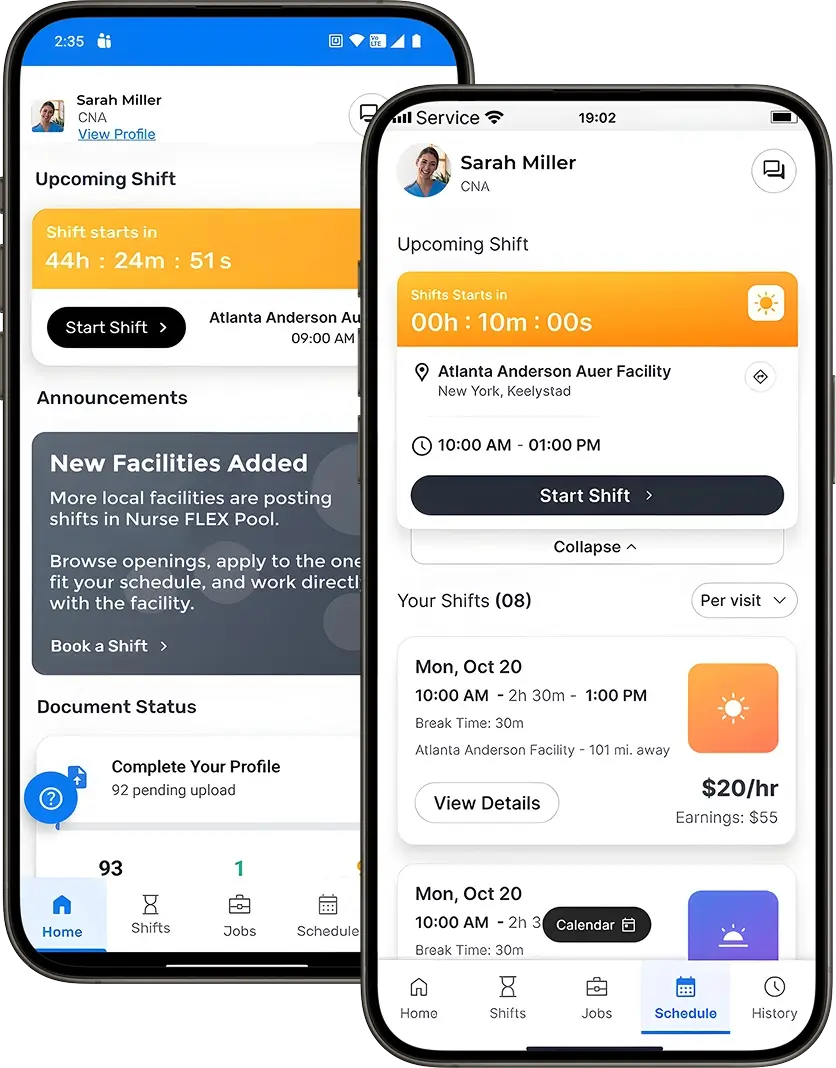
- Your team posts PRN and per diem shifts through the platform.
- Local nurses can review and apply through the mobile app workflow.
- Your facility reviews credentials and resumes, then approves the nurses you want to work.
- Over time, your team builds a more usable local Float Pool for recurring Texas outpatient shift coverage.
Which staffing option makes the most sense for Texas outpatient shift coverage?
The better staffing model depends on the type of pressure your facility is under. If the problem is a true immediate gap, one option may make more sense. If the problem is recurring PRN coverage, the economics and workflow often look very different.
| Decision factor | Agency staffing Best for immediate external fill | Internal Float Pool Best when internal infrastructure is already strong | Nurse FLEX Pool Best for recurring local PRN and per diem access |
|---|---|---|---|
| Best fit | Immediate urgent coverage | Organizations with mature internal staffing operations | Recurring PRN and per diem coverage |
| Cost structure | Hourly markups | Internal labor and management overhead | Flat monthly subscription fee |
| Speed to start | Often fastest | Fast if already built | Requires setup and adoption |
| Fee predictability | Lower predictability | Moderate to high | Higher predictability |
| Facility control | Less direct control | Highest internal control | More direct facility control |
| Fit for recurring weekly shifts | Often becomes expensive | Can work with strong internal management | Built for repeat local access |
Reachable, not just available
Each metro is its own local market
Why outpatient shift coverage in Texas requires a local model
Texas is not one uniform staffing market. The state is large, commuter patterns vary by metro, and outpatient demand is spread across ambulatory surgery centers, urgent care sites, hospital outpatient departments, specialty clinics, infusion centers, and physician-owned facilities.
That is important because practical availability matters more than theoretical supply. A nurse who is open to PRN work in one part of Dallas-Fort Worth, Houston, Austin, San Antonio, or another Texas market may not be willing to travel across a larger route for a last-minute shift. Distance, start times, case schedules, and facility familiarity all affect whether a shift is truly fillable.
This is why many outpatient nurse staffing solutions in Texas underperform over time. They may provide broad visibility, but they do not always create repeatable local access for the facility that actually needs coverage.
Why outpatient facilities feel staffing pressure differently than inpatient settings
Outpatient care depends on schedule integrity. In an ambulatory environment, staffing gaps can disrupt patient flow immediately because the day is often built around tightly sequenced visits, procedures, prep, recovery, room turnover, and discharge timing.
That pressure is increasing as more complex care moves into ambulatory settings. ASC market reporting for 2026 says higher-acuity procedures are continuing to migrate into outpatient care, including cardiovascular, spine, and advanced orthopedic procedures. That raises the operational bar for staffing, because higher-acuity outpatient care demands stronger throughput discipline, specialized support, and fewer last-minute disruptions.
For Texas outpatient leaders, that means PRN staffing is not just about coverage volume. It is about keeping the day on track.
A single outpatient day, tightly sequenced
Every step depends on the one before it — a gap on one backs up the whole day
What a local nurse pool means for outpatient care in Texas
A local nurse pool means more than having names in a database. It means having a more direct way to reach nurses who are realistically available to work near the facility that needs help and who fit the shift type, patient setting, and workflow.
That matters in outpatient care because same-day and short-notice needs are often constrained by commute friction and scheduling practicality. A nurse may be interested in per diem work, but still not be available for a specific pre-op, procedure-day, recovery, or clinic-based shift if the route is impractical.
Nurse FLEX Pool is built around this local access logic. Facilities post shifts, review nurses, and build a more repeatable workflow around the local Float Pool instead of starting from zero every time staffing gets tight.
Texas is growing the pipeline — about 220 nursing programs, 25+ approved in 5 years, 11 under review
Why Texas facilities still need better PRN staffing workflows, even as the pipeline grows
Texas is actively expanding its long-term nursing pipeline. State officials reported that Texas had about 220 approved nursing programs at the end of fiscal year 2025, with more than 25 programs approved in the past five years and 11 more under review. The Texas Center for Nursing Workforce Studies also continues to publish education, staffing, and workforce reports to support statewide planning.
Those efforts matter, but they do not solve today‘s outpatient schedule gap. Even with growth in the workforce, Texas still faces projected shortages in RNs and APRNs over the next decade. That means outpatient facilities still need a practical way to access local nurses now, while broader workforce development continues.
If your facility is trying to reduce staffing agency dependence in Texas, better staffing workflow is part of the answer, not just more market supply.
What most Texas staffing competitors emphasize, and where Nurse FLEX Pool is different
Many staffing companies serving Texas outpatient facilities position around speed, flexibility, and access to vetted clinicians. Competitor pages for outpatient clinics and ambulatory care commonly emphasize PRN coverage, credentialing, 24/7 support, rapid placement, and broad role coverage across surgery centers, urgent care, specialty clinics, and physician offices.
That positioning addresses immediate fill needs, but it usually keeps the facility inside the same hourly-fee, middleman-driven model. The message is often: call an agency when you need staff.
Nurse FLEX Pool takes a different approach. Instead of centering the model on repeated external placement fees, it gives your outpatient facility subscription-based access to a local Float Pool with a direct workflow for posting shifts, reviewing nurses, and building repeat coverage over time. That is a different economic model and a different operational model.
Built on a broader nursing marketplace
Nurses Lounge is a career marketplace for nurses. The platform connects nurses, students, schools, associations, healthcare facilities, and industry stakeholders on one professional network. That broader ecosystem matters because direct sourcing works better when facilities are not operating in isolation from the nursing profession.
For Texas outpatient care facilities, that means Nurse FLEX Pool sits inside a larger nurse-first marketplace designed to improve visibility, access, and connection with nurses across the communities you serve.
Common questions about outpatient nurse staffing in Texas
What is outpatient nurse staffing in Texas?
Outpatient nurse staffing in Texas refers to filling shifts in ambulatory care settings such as ambulatory surgery centers, urgent care sites, specialty clinics, infusion centers, and hospital outpatient departments on an as-needed basis. Facilities often use PRN or per diem staffing to cover call-outs, census variation, same-week gaps, extended hours, and recurring schedule pressure.
How can outpatient care facilities in Texas reduce staffing agency dependence?
Texas outpatient facilities can reduce staffing agency dependence by creating a more repeatable process for recurring PRN and per diem coverage. That may include building an internal Float Pool, improving direct local nurse access, or using a subscription-based staffing access model such as Nurse FLEX Pool instead of defaulting to agency use for every opening.
What is the best alternative to staffing agencies for outpatient nursing shifts in Texas?
The best alternative depends on your facility’s internal capacity and recurring shift volume. If your team already has strong recruiting and scheduling infrastructure, an internal Float Pool may work. If the problem is recurring outpatient shift coverage and cost predictability, a subscription-based model such as Nurse FLEX Pool may be a better fit because it gives your facility a more direct workflow for posting shifts, reviewing nurses, and building a local pool over time.
Why is local nurse access important for Texas outpatient shift coverage?
Local nurse access matters because practical availability determines whether a shift is truly fillable. A broad statewide list is not the same as a nurse who is willing and able to work near your location, on your schedule, in your outpatient workflow. Local access helps make repeat coverage more realistic.
How does Nurse FLEX Pool work for outpatient care facilities?
Your facility posts PRN and per diem shifts through the platform. Nurses can review and apply through the mobile app. Your team reviews credentials and resumes, approves the nurses you want to work, and uses the workflow to build a more repeatable local Float Pool over time.
Is Nurse FLEX Pool a staffing agency?
No. Nurse FLEX Pool is not a staffing agency. It is a subscription-based staffing access model that helps healthcare facilities post PRN and per diem shifts to a local Float Pool through an on-demand platform and mobile app. Nurses Lounge does not charge healthcare facilities hourly mark-up fees for access to the platform.
When does Nurse FLEX Pool make the most sense for a Texas outpatient facility?
Nurse FLEX Pool makes the most sense when your facility is dealing with recurring PRN and per diem coverage needs rather than occasional one-time emergencies. It is especially relevant when leadership wants a more predictable fee structure, more direct facility control, and a better alternative to repeated overtime and agency use.
Can outpatient nurse staffing help with staffing cost control in Texas?
It can, depending on your current staffing mix and how often you rely on premium labor. The main opportunity is not simply filling shifts. It is creating a more repeatable coverage model that can reduce overtime pressure, lower dependence on hourly markups, and improve labor cost visibility over time.
See if Nurse FLEX Pool fits your Texas outpatient staffing model
If you are looking for outpatient nurse staffing in Texas that gives you more control than agency staffing and more predictability than repeated overtime, request a demo to see how Nurse FLEX Pool fits your facility.