
Nurse Staffing Solutions for Long-Term Care Facilities in Texas
Nurse FLEX Pool is a subscription-based staffing access model from Nurses Lounge that helps Texas long-term care facilities post PRN and per diem shifts to a local Float Pool through an on-demand platform and mobile app, without hourly mark-up fees.
If your team is looking for long-term care staffing in Texas, the real question is not just how to fill the next open shift. It is how to cover recurring PRN and per diem demand in a way that gives you more control than agency staffing and a more sustainable option than repeated overtime. Nurse FLEX Pool gives Texas nursing homes and long-term care operators a third option: direct access to local nurses through a flat monthly subscription fee and a more repeatable shift coverage workflow.
Why long-term care staffing pressure is especially acute in Texas
Texas long-term care operators are dealing with a real staffing gap, not a temporary inconvenience. In Q2 2024, Texas nursing homes reported 3.30 total nurse staff hours per resident day, compared with the national average of 3.71. Texas also reported 0.38 RN hours per resident day, versus a national average of 0.60. That puts Texas near the bottom of state staffing rankings and helps explain why open shifts in skilled nursing and nursing home settings can quickly turn into overtime pressure, agency dependence, and admissions constraints.
The pressure does not stop at staffing ratios. The same Texas facilities are managing call-outs, weekend coverage, census changes, high-acuity residents, and a labor market where nurses and aides have options across hospitals, post-acute settings, home health, and travel work. In that environment, long-term care staffing in Texas becomes an operating issue, a labor cost issue, and a continuity issue at the same time.
HPRD
HPRD
What Texas nursing home leaders are actually deciding when a shift opens
When a shift opens in a Texas nursing home, the decision is bigger than one vacancy. You are deciding whether to absorb the pressure internally, pay premium rates through an outside staffing agency, or build a more repeatable local coverage model for recurring demand.
That decision is harder in long-term care because gaps often repeat in the same patterns. Nights, weekends, med pass coverage, last-minute call-outs, rehab census swings, and holiday schedules do not happen once. They happen again and again. If every repeat gap triggers the same scramble, the workflow itself becomes part of the problem.
This is why many long-term care staffing solutions in Texas solve the immediate opening but do not solve the underlying staffing model. The shift gets filled, but the cost structure stays unpredictable and the facility stays dependent on middlemen.
How Texas long-term care facilities usually handle open PRN shifts
Use agencies when urgency is the only priority
Use an internal Float Pool when your system already exists
Use Nurse FLEX Pool when the need keeps repeating
The cost of open-shift coverage keeps compounding in Texas long-term care
The external problem is clear. Texas long-term care facilities are operating in a state where staffing levels already trail national averages. In Q2 2024, only 29.3% of Texas nursing homes were at or above 3.48 total nurse staff hours per resident day, only 10.5% were at or above 4.1 HPRD, and only 6.2% were at or above 0.75 RN HPRD.
The internal problem is that your team still has to explain labor costs that remain hard to predict. Overtime may solve today’s gap, but it adds fatigue and premium pay. Agency staffing may solve today’s gap, but it adds hourly markups and weakens budget visibility. When the same patterns keep repeating, your staffing office is forced back into the same expensive choice.
The broader problem is philosophical as well as financial. A Texas nursing home should not have to rely on a staffing middleman every time it needs access to nurses and aides who already live and work in the surrounding market.
If that cycle continues, the cost of inaction is familiar: more overtime pressure, more agency dependence, less continuity, less budget control, and no durable improvement in how recurring shift coverage gets handled.
A Texas staffing agency alternative for recurring long-term care shift coverage
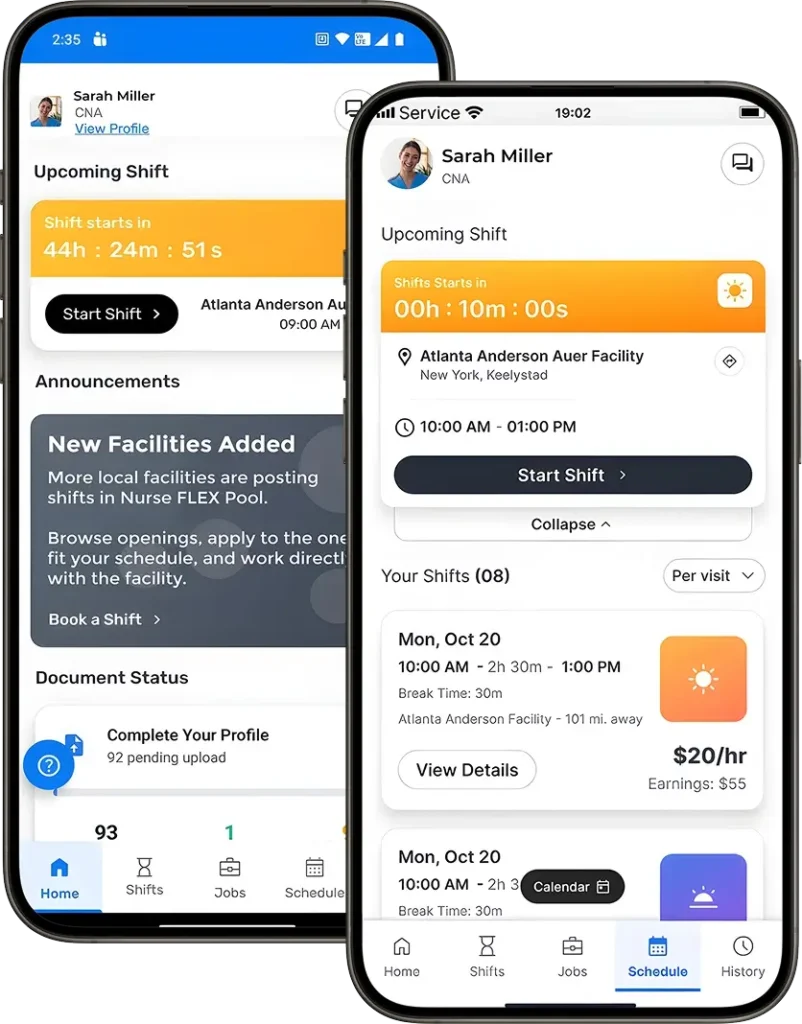
Nurse FLEX Pool gives your facility a flat monthly subscription fee and unlimited access to a local Float Pool through an on-demand staffing platform and mobile app. Instead of restarting the staffing process every time a PRN or per diem shift opens, your team can use one workflow to post shifts, review local nurses, and build a more repeatable coverage model over time.
This is what makes Nurse FLEX Pool a practical staffing agency alternative for nursing homes in Texas. It is not built around hourly markups. It is built around direct access, repeat use, and more predictable staffing economics for recurring demand.
Nurse FLEX Pool is not a staffing agency. Nurses Lounge does not charge healthcare facilities hourly mark-up fees for access to the platform.
Your facility still decides who to approve, how to manage shift coverage, and how this model fits into your broader workforce strategy.
- Your team posts PRN and per diem shifts through the platform.
- Local nurses can review and apply through the mobile app workflow.
- Your facility reviews credentials and resumes, then approves the nurses you want to work.
- Over time, your team builds a more usable local Float Pool for recurring Texas long-term care shift coverage.
Which option makes the most sense for Texas long-term care staffing?
| Decision factor | Agency staffing Best for immediate external fill | Internal Float Pool Best when internal infrastructure is already strong | Nurse FLEX Pool Best for recurring local PRN and per diem access |
|---|---|---|---|
| Best fit | Immediate urgent coverage | Organizations with mature internal staffing operations | Recurring PRN and per diem coverage |
| Cost structure | Hourly markups | Internal labor and management overhead | Flat monthly subscription fee |
| Speed to start | Often fastest | Fast if already built | Requires setup and adoption |
| Fee predictability | Lower predictability | Moderate to high | Higher predictability |
| Facility control | Less direct control | Highest internal control | More direct facility control |
| Long-term care continuity | Varies by outside availability | Depends on internal pool depth | Built around repeat use of approved local nurses |
Practical local access, not a statewide list
Why Texas long-term care shift coverage requires a local model
Texas is not one staffing market. It is a large, fragmented labor environment spread across major metros, regional hubs, and rural communities. A nurse who will work a PRN shift in one part of Dallas-Fort Worth, Houston, San Antonio, Austin, East Texas, or the Rio Grande Valley may not be willing to take a last-minute shift far outside that routine.
That matters in long-term care because practical availability is different from theoretical supply. A broad staffing list may look strong on paper, but distance, commute friction, schedule fit, facility familiarity, and pay expectations all affect whether the shift is actually fillable.
This is why Texas shift coverage solutions for long-term care need more than general staffing visibility. They need a workflow built around practical local nurse access and repeatable use.
Texas facilities still need staffing flexibility, even with changing rules
Long-term care operators in Texas have also been planning in the middle of regulatory uncertainty. In April 2025, the U.S. District Court for the Northern District of Texas vacated the 2024 CMS requirements for 24/7 RN presence and specific hours-per-resident-day staffing thresholds. That decision removed those federal requirements at that time, but it did not remove the day-to-day staffing pressure inside facilities.
The practical issue remains the same. Your building still needs coverage for open shifts, weekend patterns, resident acuity, and workforce variability. Whether the pressure comes from survey readiness, labor market constraints, quality expectations, or occupancy goals, Texas long-term care facilities still need staffing models that are more flexible and more controllable than repeated overtime and agency use.
2024 CMS staffing rule
24/7 RN presence · hours-per-resident-day thresholds
What a local nurse pool means for Texas nursing homes
A local nurse pool means more than having names in a system. It means having a more direct way to reach nurses who are realistically available to work near the facility that needs help.
That distinction matters in Texas. Competitor staffing pages often emphasize quick fulfillment, pre-screened candidates, nationwide databases, and account-manager support. Those benefits may help with broad recruiting, but they still route access through an agency model. That usually means hourly markups, variable economics, and less direct control over the long-term workflow.
Nurse FLEX Pool is built around a different logic. Your facility posts shifts, reviews nurses, and builds a more repeatable workflow around a local Float Pool rather than restarting the search every time coverage gets tight.
Why overtime and agency reliance remain such a serious issue in long-term care
The long-term care sector has been clear about how serious the staffing environment remains. In a national survey of more than 400 nursing home providers, 77% reported moderate to high staffing shortages that required agency staff or overtime, 98% said they had asked current staff to work overtime or extra shifts, and 75% said they had hired expensive temporary agency staff.
The same survey found that 55% of facilities were turning away prospective residents or patients, 48% had waiting lists, and 21% were downsizing beds or units because of staffing shortages. Even where those figures are national, they matter for Texas because Texas already reports weaker staffing levels than the national average.
If you are a Texas long-term care operator, that creates pressure at three levels:
- External problem: the labor market is tight and recurring coverage is hard to secure
- Internal problem: your team is stuck defending premium labor decisions that keep repeating
- Philosophical problem: access to local nurses should not require a middleman every time a shift opens
staffing shortages needing agency or OT
Where Nurse FLEX Pool fits in a Texas long-term care staffing plan
Facilities typically use Nurse FLEX Pool access for:
call-outs and short-notice gaps
recurring weekend coverage
nights and holiday staffing pressure
census-driven schedule compression
unit-specific PRN demand
repeat LVN, RN, and support coverage patterns where the same gaps keep returning
This model is especially relevant when you do not want every open shift to trigger one of two costly choices: internal overtime or external agency spend.
Built on a broader nursing marketplace
Nurses Lounge is a career marketplace for nurses. The platform connects nurses, students, schools, associations, healthcare facilities, and industry stakeholders on one professional network. That broader ecosystem matters because direct sourcing works better when facilities are not operating in isolation from the nursing profession.
For Texas long-term care facilities, that means Nurse FLEX Pool sits inside a larger nurse-first marketplace designed to improve visibility, access, and connection with nurses across the communities you serve.
Common questions about nurse staffing solutions for long-term care facilities in Texas
What are nurse staffing solutions for long-term care facilities in Texas?
Nurse staffing solutions for long-term care facilities in Texas are the systems facilities use to cover open nursing and aide shifts, including overtime, staffing agencies, internal Float Pools, and direct-access platforms. The best option depends on whether your main issue is urgent fill speed, recurring PRN volume, cost predictability, or facility control.
What is the best staffing agency alternative for nursing homes in Texas?
The best staffing agency alternative for nursing homes in Texas is usually a model that improves direct access to local nurses while reducing repeated hourly markup costs. For some operators, that may be an internal Float Pool. For others, a subscription-based staffing access model such as Nurse FLEX Pool makes more sense because it supports recurring PRN and per diem coverage without hourly mark-up fees.
How can long-term care facilities in Texas reduce overtime and agency reliance?
Texas long-term care facilities can reduce overtime and agency reliance by creating a more repeatable process for recurring shift coverage instead of treating every opening as a one-off emergency. That can include strengthening internal scheduling, building a local pool of approved nurses, and using a subscription-based model that avoids hourly markups. The exact impact depends on shift volume, staffing mix, and current agency use.
Is Nurse FLEX Pool a staffing agency?
No. Nurse FLEX Pool is not a staffing agency. It is a subscription-based staffing access model that helps healthcare facilities post PRN and per diem shifts to a local Float Pool through an on-demand platform and mobile app. Nurses Lounge does not charge healthcare facilities hourly mark-up fees for access to the platform.
Why does local access matter for Texas long-term care staffing?
Local access matters because Texas is a large and uneven labor market. A nurse may be open to shifts near one facility but not willing to take a last-minute opening far outside that area. For recurring PRN and per diem staffing, practical local access is often what determines whether coverage becomes repeatable.
What kinds of shifts can Texas nursing homes post through Nurse FLEX Pool?
Texas nursing homes can use Nurse FLEX Pool for recurring PRN and per diem staffing needs such as call-outs, nights, weekends, holiday coverage, census spikes, and recurring unit gaps. The platform is designed for repeat shift coverage, not just one-time emergencies.
How do facilities keep control over staffing decisions?
Your team keeps control. Facilities review credentials and resumes, decide which nurses to approve, and manage how the model fits into their broader staffing plan. Over time, that creates a more trusted local Float Pool and a more repeatable workflow.
Why is Texas long-term care staffing under so much pressure right now?
Texas facilities are balancing weaker staffing levels than national averages, ongoing labor competition, recurring call-outs, weekend coverage needs, and financial pressure tied to overtime and agency use. In Q2 2024, Texas nursing homes reported 3.30 total nurse staff HPRD and 0.38 RN HPRD, both below national averages. That makes recurring shift coverage harder to manage without a better local model.
When does Nurse FLEX Pool make the most sense for a Texas long-term care facility?
Nurse FLEX Pool makes the most sense when your facility is dealing with recurring PRN and per diem coverage needs rather than occasional one-time emergencies. It is especially relevant when leadership wants a more predictable fee structure, more direct facility control, and a better alternative to repeated overtime and agency use.
Is Nurse FLEX Pool right for every long-term care facility in Texas?
No. If your organization already has a highly effective internal process for recurring PRN coverage, you may need less outside support. Nurse FLEX Pool is best suited for facilities that want a more direct and repeatable staffing model than relying only on overtime or staffing agencies.