
How Can Hospitals Reduce Overtime and Agency Reliance?
Hospitals reduce overtime and agency reliance by building a more repeatable shift coverage model for recurring PRN and per diem demand. That usually means relying less on last-minute premium labor and improving access to a trusted nurse pool your team can return to when open shifts keep repeating.
Nurse FLEX Pool is a subscription-based staffing access model from Nurses Lounge that helps healthcare facilities post PRN and per diem shifts to a local Float Pool through an on-demand platform and mobile app, without hourly mark-up fees. Instead of treating every shift as a one-off staffing event, your team gets a more direct workflow for shift coverage, nurse review, and repeat use.
If you are trying to reduce overtime and agency reliance, the real question is not just how to fill the next shift. It is how to stop repeating an expensive staffing cycle that strains your budget, burdens your core team, and still leaves recurring coverage gaps unresolved.
Why reducing overtime and agency reliance is an urgent hospital staffing issue
The staffing pressure is real, and it is not easing on its own. The 2026 NSI National Health Care Retention & RN Staffing Report says hospital turnover reached 18.5%, RN turnover reached 17.6%, RN vacancy stands at 8.6%, and one-third of hospitals report vacancy rates of 10% or more. The same report estimates an average hospital still has 43 unfilled RN FTEs and that it takes about 78 days to recruit an experienced RN.
When those vacancies collide with call-outs, census changes, nights, weekends, and unit-specific demand, hospital leaders usually fall back on the same two levers: overtime or outside agency labor. Both may solve the immediate problem, but neither creates a durable workforce strategy.
That is why hospital staffing cost control is not just a finance issue. It is also an operations issue, a retention issue, and a workforce sustainability issue.
What hospital leaders are actually deciding when a shift opens
A shift opens, and the question sounds simple: how do you cover it? But what you are really deciding is whether to absorb the pressure internally, pay for it through hourly markups, or put a more structured local coverage model in place.
The external problem is rising labor cost pressure in a market where demand for healthcare workers continues to outpace supply. The internal problem is that your team still has to explain budget variance, burnout, and recurring open-shift stress to finance, operations, and clinical leadership. The philosophical problem is that hospitals should not have to rely on a middleman every time they need access to nurses who are already in their labor market.
If that decision keeps defaulting to overtime or agency staffing, the cost of inaction compounds: more premium labor spend, more fatigue, less continuity, and less confidence in your staffing plan.
Agency
FLEX Pool
How hospitals usually handle recurring shift coverage
The best staffing path depends on what kind of pressure your organization is under: an immediate coverage emergency, a strong internal staffing infrastructure, or recurring dependence on premium labor.
Use overtime when the issue is isolated and truly short term
Overtime can be the fastest internal option when the gap is limited and the team has short-term capacity. The tradeoff is clear: labor cost increases immediately, and repeated use adds burnout pressure to the same workforce you are trying to retain.
Use agencies when urgency outweighs cost control
Agency staffing may still be the practical option when a shift must be filled externally and there is no better workflow already in place. But the pricing model is hard to ignore. DirectShifts states agency travel nurse bill rates in 2026 commonly range from $80 to $120 per hour, with 25% to 40% of the bill often going to agency margin. Their example puts a 12-hour agency shift at $1,080 at a $90 hourly bill rate.
Use an internal Float Pool when your infrastructure is already mature
An internal Float Pool can work well if your hospital already has the recruiting, credentialing, scheduling, and management capacity to keep it full and active. But many organizations do not struggle with the idea of a float pool, they struggle with the ongoing work needed to build and maintain one at scale.
Use Nurse FLEX Pool when the need keeps repeating
Nurse FLEX Pool is built for recurring PRN and per diem demand. It gives healthcare facilities a third option: a subscription-based staffing access model that helps your team post shifts, review nurses, and build a more repeatable local Float Pool without defaulting to hourly agency markups every time pressure returns.
The cost of open-shift coverage keeps compounding
Hospitals are under pressure from several directions at once. NSI reports the average cost of bedside RN turnover is $60,090, and the average hospital loses between $4.2 million and $6.2 million annually because of RN turnover. The same report says each 1% change in RN turnover can cost or save the average hospital about $295,000 per year.
That is the financial backdrop behind every staffing decision. When recurring shifts are covered through premium overtime or marked-up agency labor, the immediate fill may look operationally necessary, but the long-term labor model becomes harder to defend.
Overtime creates internal strain. Agency staffing creates external dependency. Neither one automatically improves your ability to cover the next 20 shifts more predictably than the last 20.
If nothing changes, you are not just paying more for labor. You are normalizing a staffing workflow that keeps labor cost volatile and keeps your core staff under pressure.
A staffing agency alternative built for recurring hospital shift coverage
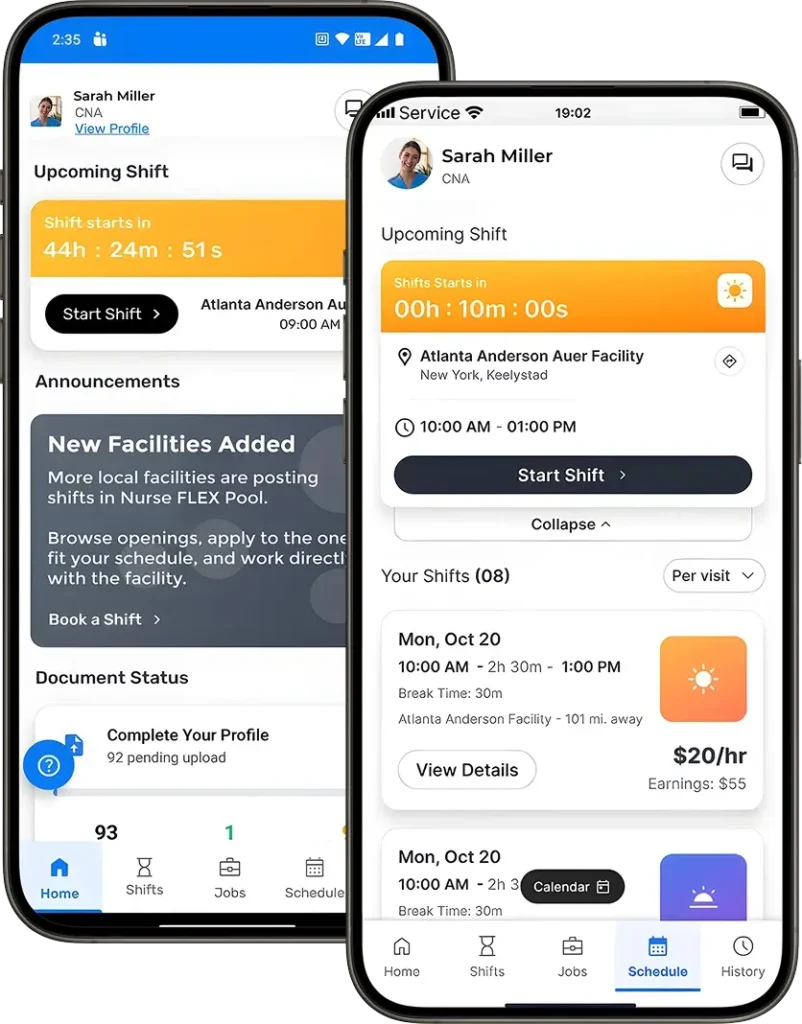
Nurse FLEX Pool gives your facility a flat monthly subscription fee and unlimited access to a curated local Float Pool through an on-demand staffing platform and mobile app. Instead of restarting the staffing process every time a PRN or per diem shift opens, your team can use one workflow to post shifts, review nurses, and build a stronger repeat-use pool over time.
Nurses Lounge is not a staffing agency and does not charge healthcare facilities hourly mark-up fees. Nurse FLEX Pool is subscription-based staffing access. Your team controls which shifts get posted, which nurses are reviewed, and which nurses are approved.
This is the model shift. You move from paying a middleman each time coverage gets tight to building a more direct and repeatable staffing workflow for recurring demand.
- Your team posts PRN and per diem shifts through the platform.
- Local nurses review and apply through the mobile app workflow.
- Your facility reviews credentials and resumes, then approves the nurses you want to work.
- Hours are logged digitally, and over time your team builds a more usable local Float Pool for future shift coverage.
Which option makes the most sense for hospital staffing cost control?
The right answer depends on what problem you are trying to solve. If the issue is a true emergency, one option may be justified. If the issue is recurring PRN and per diem coverage, the economics and workflow usually look very different.
| Decision factor | Overtime Best for short-term internal coverage | Agency staffing Best for immediate outside fill | Nurse FLEX Pool Best for recurring PRN and per diem access |
|---|---|---|---|
| Best fit | Isolated gaps with temporary internal capacity | High-urgency external coverage | Recurring open shifts and repeat demand |
| Cost structure | Premium hourly labor cost | Hourly markups and variable bill rates | Flat monthly subscription fee |
| Budget predictability | Low to moderate | Lower predictability | Higher predictability |
| Operational control | High, but strains staff | Lower direct control | More direct facility control |
| Continuity potential | Moderate | Often inconsistent | Stronger repeat-use potential |
| Burnout impact | Often increases over time | Can reduce internal load, but not dependency | Helps reduce repeated overtime pressure |
| Fit for recurring weekly shifts | Usually hard to sustain | Often becomes expensive | Built for repeat local access |
Demand is outpacing supply
Why the labor market keeps pushing hospitals toward overtime and agencies
The broader healthcare labor market helps explain why many hospitals feel stuck. The U.S. Bureau of Labor Statistics projects about 1.9 million healthcare openings each year through 2034 because of growth and replacement demand. NSI also notes that all Baby Boomers will reach retirement age by 2030, increasing both patient care demand and workforce replacement pressure.
In practice, that means recurring gaps are not just a scheduling problem. They are a market-structure problem. Supply is uneven, experienced RNs remain hard to recruit, and demand spikes do not wait for hiring cycles to catch up.
That is why hospitals need alternatives to overtime and staffing agencies that work in the real flow of open-shift operations, not just in workforce planning spreadsheets.
Why a local nurse pool matters when hospitals need better shift coverage
A local Float Pool means more than having names in a database. It means your facility has a practical way to reach nurses who are realistically available to work the types of shifts your organization needs filled.
Competitor pages consistently position this same idea as a core advantage. Supplemental Health Care emphasizes fast access to a pre-credentialed float pool and PRN staffing support for fluctuating demand. Medely emphasizes unified labor-source planning across full-time, float, per diem, and agency labor. DirectShifts emphasizes IRP bench-building as the key to reducing agency spend over time. Those pages differ in model, but they all point to the same operational truth: you reduce premium labor dependence by strengthening your access to a repeatable nurse pool, not by negotiating one more urgent shift.
Nurse FLEX Pool is built around that local access logic. Facilities post shifts, review nurses, and develop a stronger repeat-use workflow rather than starting from zero each time coverage gets tight.
Where hospitals can reduce overtime and agency use first
Most hospitals do not eliminate premium labor all at once. They start where recurring demand is most visible and most expensive. Practical starting points often include:
Call-outs and short-notice gaps
Nights, weekends, and holiday coverage
Seasonal demand swings and census spikes
Schedule compression when multiple units are tight at once
Recurring PRN coverage gaps on specific units
Patterns that repeatedly trigger overtime approvals or agency calls
DirectShifts notes that organizations typically reduce agency spend over 12 to 18 months as the bench grows, with mature models reducing agency spend by 50% to 80% compared with baseline. That does not mean every hospital will see the same result, but it reinforces a practical point: sustainable staffing cost control usually comes from changing the coverage model over time, not from one-time rate negotiation.
How Nurse FLEX Pool fits into a broader nurse staffing solution
Nurse FLEX Pool is not designed to replace every labor source in every situation. It is designed to give your organization a more predictable option for recurring PRN and per diem coverage.
That makes it especially relevant for CNOs, staffing office leaders, HR leaders, and finance leaders who need a credible third option between repeated overtime and repeated agency use. Our messaging is built for healthcare facility leaders evaluating alternatives to overtime and staffing agencies.
If your team already has a strong internal Float Pool, Nurse FLEX Pool may support broader local access and repeat coverage workflows. If your organization has been defaulting to agencies and overtime, it may serve as the model shift that gives you more control over how recurring demand is handled.
every time
Built on a broader nursing marketplace
Nurses Lounge is a career marketplace for nurses. The platform connects nurses, students, schools, associations, healthcare facilities, and industry stakeholders on one professional network. That broader ecosystem matters because direct sourcing works better when facilities are not trying to solve staffing in isolation.
For healthcare facilities, that means Nurse FLEX Pool sits inside a larger nurse-first marketplace designed to improve visibility, access, and connection with nurses over time.
Common questions about how hospitals can reduce overtime and agency reliance
What is the best way for hospitals to reduce overtime and agency reliance?
The best way is usually to create a more repeatable staffing model for recurring PRN and per diem demand. That can include strengthening an internal Float Pool, improving direct access to local nurses, and using a subscription-based staffing access model instead of defaulting to premium overtime or hourly agency markups for every opening.
Why does overtime become so expensive for hospitals?
Overtime raises hourly labor cost immediately, but the bigger issue is repetition. When the same units, time blocks, or shift types keep depending on overtime, the organization pays more while also increasing fatigue and burnout pressure on the staff it is trying to retain.
Why do hospitals become dependent on staffing agencies?
Hospitals often become dependent on staffing agencies when recurring coverage gaps keep appearing faster than recruiting and internal scheduling workflows can solve them. Agencies can fill urgent gaps, but if they become the default solution for recurring demand, costs stay volatile and the facility never improves its own repeat-use coverage model.
What is a staffing agency alternative for hospitals?
A staffing agency alternative is any model that helps the facility access nurses more directly and predictably. That may be an internal Float Pool, a direct sourcing model, or a subscription-based staffing access platform such as Nurse FLEX Pool.
Is Nurse FLEX Pool a staffing agency?
No. Nurse FLEX Pool is not a staffing agency. Nurses Lounge does not charge healthcare facilities hourly mark-up fees. Nurse FLEX Pool is a subscription-based staffing access model that helps facilities post PRN and per diem shifts to a local Float Pool through an on-demand platform and mobile app.
How does Nurse FLEX Pool work?
Your team posts PRN and per diem shifts through the platform. Nurses review and apply through the mobile app. Your facility reviews credentials and resumes, approves the nurses you want to work with, and builds a stronger repeat-use Float Pool over time. Hours are logged digitally, and the subscription begins after the first shift is filled.
Who should evaluate a model like Nurse FLEX Pool?
It is most relevant for hospital and health system leaders responsible for safe staffing levels, labor cost control, workforce planning, and recurring open-shift coverage. That often includes CNOs, nursing directors, staffing office leaders, HR leaders, and finance leaders.
Is reducing agency spend the same as eliminating agencies completely?
No. Many organizations use a phased approach. The goal is usually to reduce dependence on agencies for recurring routine coverage, while keeping outside staffing available for true spikes, specialty gaps, or urgent exceptions.
See if Nurse FLEX Pool fits your staffing model
If you are looking for a better answer to overtime pressure and agency dependence, Nurse FLEX Pool gives your team a more direct way to manage recurring PRN and per diem coverage through a local Float Pool and a flat monthly subscription fee.
Schedule a demo to see how it fits your facility. If you are not ready for a full review yet, learn more about how the model works and where it fits in your broader workforce strategy.