
Flat Fee Nurse Staffing Access for Texas Healthcare Facilities
Nurse FLEX Pool is a subscription-based staffing access model from Nurses Lounge that helps Texas healthcare facilities post PRN and per diem shifts to a local Float Pool through an on-demand platform and mobile app, without hourly mark-up fees. It is built for facilities that need a more predictable way to handle recurring shift coverage across a tight labor market.
If your team is looking for flat fee nurse staffing access in Texas, the decision is bigger than filling the next opening. You are deciding whether recurring PRN and per diem demand will keep hitting your budget as variable agency spend, or whether your facility will move to a more repeatable staffing workflow with a flat monthly subscription fee and unlimited access to a local nurse pool. Nurse FLEX Pool gives Texas facilities a third option between repeated overtime and hourly mark-up staffing agencies.
Why nurse staffing access is a bigger budgeting issue in Texas right now
Texas is growing quickly, and healthcare facilities are carrying the staffing burden that comes with that growth. The Texas Hospital Association says the state continues to lead the nation in both population and job growth, and some estimates show Texas added nearly 30,000 people per month over the past decade. Just maintaining current staffing levels could require roughly 2,100 to 2,700 additional healthcare workers every month statewide. For nursing leaders, that means recurring shift coverage pressure is not easing on its own.
At the same time, workforce constraints remain real. THA reports that more than 60% of Texas hospitals were operating with fewer beds and reduced services in 2023 due to lack of staff. It also projects demand for full-time registered nurses in Texas will outpace supply by more than 57,000 positions by 2032, a 16% deficit. In this environment, open-shift coverage becomes a financial planning issue as much as a scheduling issue.
What Texas healthcare leaders are actually deciding when a shift opens
A shift opens, and the immediate question sounds operational. Who can cover it? But the real decision is economic and strategic. Are you going to absorb the pressure through overtime, pay a premium through hourly markups, or create a more controlled local access model for recurring PRN staffing?
That decision is harder in Texas because staffing pressure is spread across major hospital systems, community hospitals, post-acute operators, and fast-growing metro and suburban markets at the same time. The state’s healthcare and social assistance sector has grown 123% over the past 30 years, adding more than one million jobs, yet state officials still say workforce demand is outpacing supply. A broad staffing list is not the same thing as practical shift coverage near the facility that needs help.
This is why many Texas nurse staffing solutions solve the immediate opening without solving the recurring workflow problem behind it.
Agency
FLEX Pool
How Texas facilities usually handle PRN staffing today
The right staffing path depends on what is creating the most pressure: an urgent same-day hole, an already mature internal staffing operation, or recurring dependence on agencies and overtime.
Use agencies when immediate urgency outweighs cost predictability
Traditional staffing agencies can still be the practical choice when a shift must be filled immediately and there is no local workflow already in place. But agency economics are built around bill rates, markups, and variable costs. That may solve the current opening while making recurring coverage harder to budget over time.
Use an internal Float Pool when your infrastructure is already strong
An internal Float Pool can work well when your organization already has the recruiting, credential review, scheduling, and operational management needed to keep it running. Larger systems may already have that foundation. But many facilities still need a simpler way to access local nurses without building every part of the model from scratch.
Use Nurse FLEX Pool when recurring coverage keeps returning
Nurse FLEX Pool is designed for recurring PRN and per diem staffing demand. It gives Texas healthcare facilities a more direct way to post shifts to a local Float Pool through a subscription-based model with unlimited access, instead of defaulting to hourly agency markups every time demand returns.
The cost of shift coverage in Texas keeps compounding
The external problem is a Texas healthcare market where patient demand is growing, workforce supply is constrained, and facilities are still expected to maintain safe coverage.
The internal problem is that your team still has to defend labor spend that swings month to month. Call-outs, weekends, holidays, seasonal surges, recurring census pressure, and hard-to-fill units can keep forcing the same premium-rate decisions.
The broader problem is philosophical as well as financial. A Texas healthcare facility should not have to rely on a middleman every time it needs access to qualified nurses who already live and work in the state.
If that cycle continues, the cost of inaction is familiar: more overtime pressure, more agency dependence, lower budget visibility, more management friction, and no durable improvement in how recurring PRN and per diem staffing gets handled.
A Texas staffing agency alternative built around flat monthly access
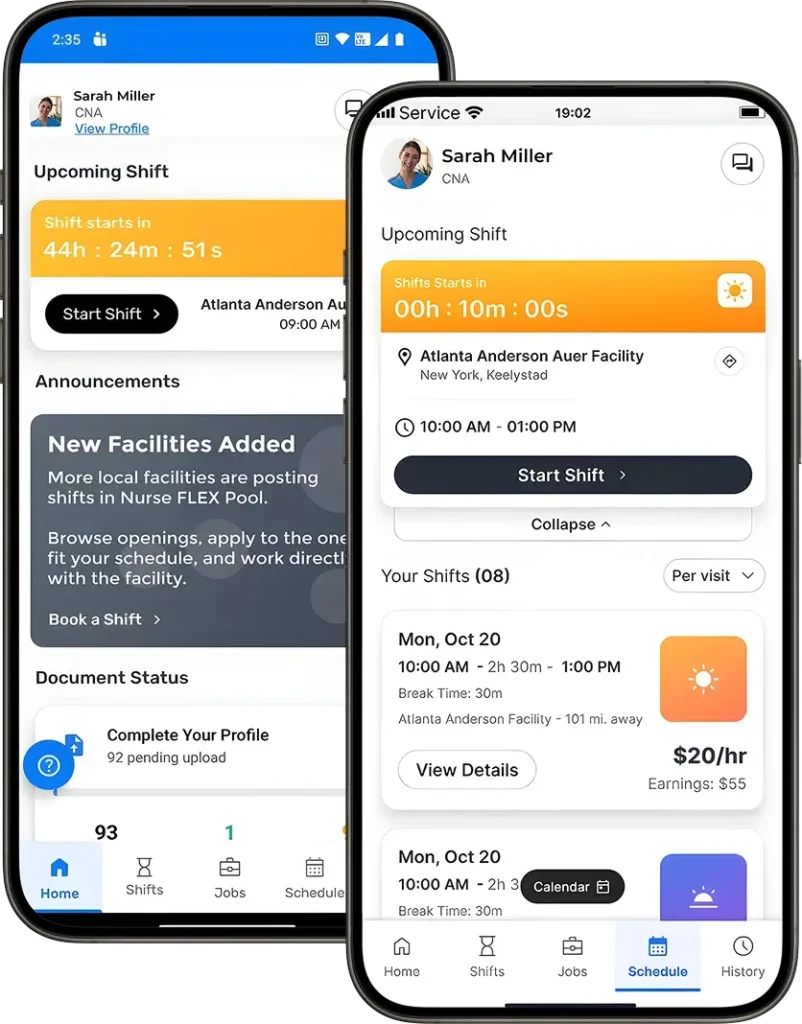
Nurse FLEX Pool gives your facility a flat monthly subscription fee and unlimited access to a local Float Pool through an on-demand staffing platform and mobile app. Instead of restarting the staffing process every time a PRN or per diem shift opens, your team can use one workflow to post shifts, review local nurses, and build a more repeatable coverage model over time.
This is what makes Nurse FLEX Pool a practical flat fee nurse staffing option for Texas healthcare facilities. It is not built around per-shift agency markups. It is built around direct access, repeat use, and more predictable staffing economics for recurring demand.
Nurse FLEX Pool is not a staffing agency. Nurses Lounge does not charge healthcare facilities hourly mark-up fees for access to the platform.
Your facility still decides who to approve, how to manage shift coverage, and how this model fits into your broader workforce strategy. Nurses can apply through the app, your team reviews credentials and resumes, and digital timesheets help track hours worked.
- Your team posts PRN and per diem shifts through the platform.
- Local nurses review and apply through the mobile app workflow.
- Your facility reviews credentials and resumes, then approves the nurses you want to work.
- Over time, your team builds a more usable local Float Pool for recurring Texas shift coverage.
- Subscription payments begin after your first shift is filled, helping reduce adoption friction for facilities evaluating a new staffing model.
Which nurse staffing model makes the most sense for Texas facilities?
The better staffing model depends on the type of pressure your facility is under. If the issue is a one-time emergency, one option may fit best. If the issue is recurring PRN coverage, the economics and workflow usually look very different.
| Decision factor | Agency staffing Best for immediate external fill | Internal Float Pool Best when internal infrastructure is already strong | Nurse FLEX Pool Best for recurring local PRN and per diem access |
|---|---|---|---|
| Best fit | Immediate urgent coverage | Mature internal staffing operations | Recurring PRN and per diem coverage |
| Cost structure | Hourly markups, bill-rate variability, possible placement or conversion fees | Internal labor and management overhead | Flat monthly subscription fee |
| Budget visibility | Lower predictability | Moderate to high | Higher predictability |
| Facility control | Less direct control | Highest internal control | More direct facility control |
| Local repeat use | Varies by agency rotation | Strong if pool is already built | Built for repeat local access |
| Setup burden | Low at point of need | High if building from scratch | Moderate setup, then repeatable workflow |
| Fit for recurring weekly shifts | Often becomes expensive | Can work with strong internal management | Built for ongoing access without hourly mark-up fees |
Why flat fee nurse staffing access matters in Texas specifically
Texas is not one uniform staffing market. It is a statewide healthcare economy shaped by large metro systems, suburban growth corridors, rural access challenges, and long travel patterns between facilities and labor pools. The same state association that tracks workforce conditions says shortages vary by profession, geography, and community need. That is why a staffing strategy that looks broad on paper may still break down at the shift level.
This is also a state where pipeline development is still catching up. Texas nursing schools turned away 13,705 qualified applications in 2023 due to faculty and clinical-space constraints. Even though Texas added 23 new nursing education programs between 2020 and 2024, facilities still need practical shift coverage solutions now, not just future pipeline gains.
For many Texas facilities, the issue is not whether nurses exist somewhere in the market. It is whether your team has a reliable way to reach local nurses without turning every recurring opening into another variable-cost agency event.
What a local nurse pool means for Texas shift coverage
A local nurse pool means more than a database of names. It means a more direct way to reach nurses who are realistically available to work near the facility that needs help, under a workflow your team can reuse.
That matters in Texas because commute friction is real. Competitor pages keep emphasizing local coverage in Dallas, Fort Worth, Houston, San Antonio, Austin, suburban markets, and rural communities because practical availability matters as much as theoretical supply. If a nurse is open to shifts in one part of a metro area, that does not automatically mean they are available for a last-minute shift across a wider Texas commute.
Nurse FLEX Pool is built around this local-access logic. Facilities post shifts, review nurses, and build a more repeatable workflow around a local Float Pool instead of starting from zero every time coverage gets tight.
Why Texas facilities still need better staffing workflows even while the pipeline expands
Texas is investing in long-term workforce development. THA points to programs such as SB 25 reforms, nurse preceptor grant efforts, loan repayment support, and the Texas-born SNAPPI model that expands clinical training capacity by allowing registered nurses to teach students in the units where they already practice.
Those efforts matter, and they should help over time. But long-term pipeline progress does not remove the need for more predictable PRN staffing access today. If your facility is still dealing with recurring open shifts, budget pressure, and premium labor decisions, the immediate question remains the same: how do you access local nurses more directly and manage recurring coverage with more control right now?
How a flat monthly subscription changes budgeting versus hourly agency staffing
Traditional staffing agency pricing is usually tied to an hourly bill rate above the clinician pay rate, and some models can also include placement or conversion fees. That means your labor spend can rise every time demand rises. The model is responsive, but it is also inherently variable.
A flat monthly subscription changes the conversation. Instead of asking what each individual shift will cost through an external intermediary, your team can plan around one predictable access fee and use the platform repeatedly for recurring PRN and per diem demand. That does not eliminate the need for workforce strategy. It gives leadership a cleaner budgeting framework for handling the same recurring staffing patterns.
For CFOs, CNOs, and HR leaders, that pricing-model shift matters because it can move contingent staffing from repeated variable-cost decisions toward a more stable operating model. It is a board-ready answer to a labor-cost problem that keeps compounding, especially when shift volume is recurring rather than rare.
Built on a broader nursing marketplace
Nurses Lounge is a career marketplace for nurses. The platform connects nurses, schools, associations, healthcare facilities, and industry stakeholders on one professional network. That broader ecosystem matters because direct sourcing works better when facilities are not operating in isolation from the nursing profession.
For Texas healthcare facilities, that means Nurse FLEX Pool sits inside a larger nurse-first marketplace designed to improve visibility, access, and connection with nurses across the communities you serve.
Common questions about flat fee nurse staffing access in Texas
What is flat fee nurse staffing access in Texas?
Flat fee nurse staffing access in Texas refers to a model where a healthcare facility pays a predictable monthly subscription for access to a staffing platform or nurse pool, rather than paying hourly agency markups on each shift. In the Nurses Lounge model, Nurse FLEX Pool gives facilities unlimited access to a local Float Pool for recurring PRN and per diem staffing needs.
How can Texas healthcare facilities access nurses without hourly agency markups?
Texas healthcare facilities can reduce reliance on hourly agency markups by using an internal Float Pool, a direct-access staffing platform, or a blended workforce strategy. Nurse FLEX Pool is built for facilities that want a more repeatable workflow for posting shifts, reviewing local nurses, and managing recurring PRN and per diem coverage through a flat monthly subscription fee.
Is Nurse FLEX Pool a staffing agency?
No. Nurse FLEX Pool is not a staffing agency. It is a subscription-based staffing access model that helps healthcare facilities post PRN and per diem shifts to a local Float Pool through an on-demand platform and mobile app. Nurses Lounge does not charge healthcare facilities hourly mark-up fees for access to the platform.
What does the Nurse FLEX Pool subscription include?
A Nurse FLEX Pool subscription includes unlimited posting and filling of PRN and per diem shifts, access to the Nurse FLEX Pool workflow, a Marketplace facility presence with permanent jobs imported to the job map, and the ability to post new grad nurse residencies in the Residency Programs directory.
Why does local nurse access matter for Texas facilities?
Local nurse access matters because practical shift coverage depends on where nurses are actually willing and able to work. In a state as large as Texas, commute distance, metro sprawl, suburban growth, and facility location all affect whether an opening is realistically fillable. That is why repeat local access is often more useful than broad theoretical reach.
What is the best alternative to hourly mark-up staffing agencies in Texas?
The best alternative depends on your facility’s situation. If you already have a mature internal Float Pool, that may be enough. If your challenge is recurring PRN and per diem demand with poor budget visibility, a subscription-based staffing access model such as Nurse FLEX Pool may be a better fit because it replaces variable hourly agency pricing with a flat monthly subscription fee.
How does a subscription-based nurse staffing solution help with budgeting?
A subscription-based nurse staffing solution helps with budgeting by replacing repeated variable agency charges with a more predictable monthly access cost. That can make recurring staffing demand easier to plan for, especially when your facility regularly deals with open PRN shifts, call-outs, weekends, holidays, or volume spikes.
When does Nurse FLEX Pool make the most sense for a Texas facility?
Nurse FLEX Pool makes the most sense when a Texas healthcare facility is dealing with recurring PRN and per diem coverage needs rather than occasional one-time emergencies. It is especially relevant when leadership wants more predictable budgeting, more direct facility control, and a more sustainable alternative to repeated overtime and staffing agency use.
See if Nurse FLEX Pool fits your Texas staffing model
If you are looking for flat fee nurse staffing access in Texas that gives you more control than agency staffing and more predictability than repeated overtime, schedule a demo to see how Nurse FLEX Pool fits your facility. We can walk through how the subscription works, where it fits in your staffing plan, and whether it makes sense for your recurring shift volume.