
Nurse Staffing Solutions for Behavioral Health Facilities in Texas
Nurse FLEX Pool is a subscription-based staffing access model from Nurses Lounge that helps behavioral health facilities in Texas post PRN and per diem nursing shifts to a local Float Pool through an on-demand platform and mobile app, without hourly mark-up fees.
If your team is looking for behavioral health staffing in Texas, the real question is not just how to fill the next psychiatric or mental health nursing shift. It is how to cover recurring PRN and per diem demand in a way that gives you more control than agency staffing and a more sustainable option than repeated overtime. Nurse FLEX Pool gives Texas behavioral health facilities a third option: direct access to local nurses through a flat monthly subscription fee and a more repeatable shift coverage workflow.
Why behavioral health nurse staffing is a bigger issue in Texas right now
Texas behavioral health facilities are operating in a market where demand is rising, workforce supply is uneven, and staffing pressure is not limited to one metro. Texas continues to face critical shortages across the behavioral health workforce, including advanced practice psychiatric nurses and other mental health professionals. Nearly the entire state remains designated as a mental health shortage area, and statewide access gaps are still shaping daily staffing decisions.
At the same time, behavioral health capacity is expanding. In June 2026, Texas opened the new Texas Behavioral Health Center in Dallas, a 292-bed inpatient psychiatric hospital, as part of more than $2.5 billion in statewide state hospital investment since 2017. More beds and more behavioral health demand increase the need for dependable nurse shift coverage, especially for nights, weekends, admissions activity, and recurring unit gaps.
That is why nurse staffing for behavioral health facilities in Texas is not just a recruiting issue. It is an operating issue tied to coverage reliability, overtime exposure, budget control, and whether your team has a practical process for recurring open shifts.
What Texas behavioral health leaders are actually deciding when a shift opens
A shift opens, and the staffing question sounds simple. But for behavioral health facilities in Texas, the real decision is bigger than one vacancy. You are deciding whether to absorb the pressure internally, pay for it through agency markups, or create a more repeatable local coverage model for recurring PRN and per diem demand.
That decision is harder in behavioral health because shift coverage is not just about headcount. It is also about unit familiarity, supervision, patient acuity, admissions flow, documentation expectations, and facility-specific processes. Texas psychiatric settings are also governed by staffing and oversight requirements that make coverage quality and continuity especially important.
This is why many behavioral health staffing solutions in Texas break down over time. They solve the immediate opening, but they do not solve the recurring workflow problem behind it.
How Texas behavioral health facilities usually handle PRN staffing
The right staffing path depends on what is creating the most pressure: a same-day hole, limited internal staffing infrastructure, or recurring dependence on agencies and overtime.
Use agencies when urgency is the only priority
Use an internal Float Pool when the system already exists
Use Nurse FLEX Pool when the need keeps repeating
The cost of behavioral health shift coverage keeps compounding
The external problem is ongoing staffing pressure in a Texas behavioral health market where provider shortages remain widespread and coverage needs continue to rise.
The internal problem is that your team still has to justify labor costs that remain hard to predict, even though the same shift patterns keep repeating. Call-outs, admissions, higher-acuity patients, weekend demand, and recurring unit gaps can all push the organization back into the same forced choice.
The broader problem is philosophical as well as financial. A behavioral health facility in Texas should not have to rely on a staffing middleman every time it needs access to qualified nurses who already live and work in the community.
If that cycle continues, the cost of inaction is familiar: more overtime pressure, more agency dependence, less budget visibility, more management friction, and no durable improvement in how recurring PRN and per diem coverage gets handled.
A Texas behavioral health staffing agency alternative built for recurring shift coverage
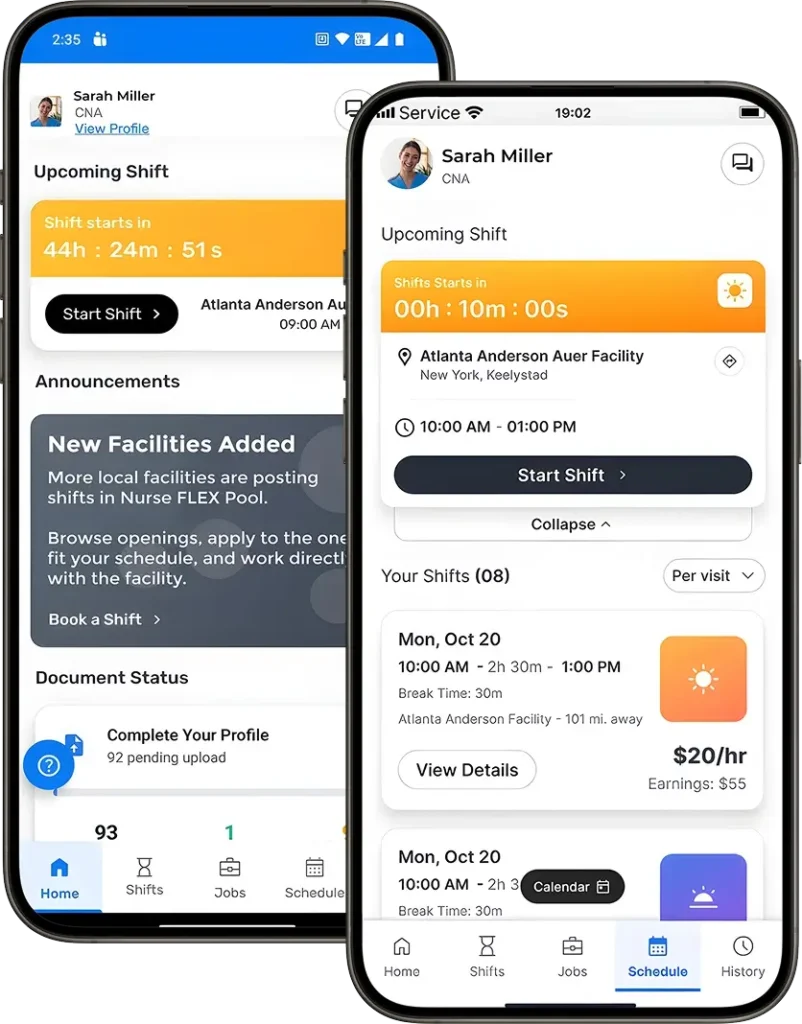
Nurse FLEX Pool gives your facility a flat monthly subscription fee and unlimited access to a local Float Pool through an on-demand staffing platform and mobile app. Instead of restarting the staffing process every time a PRN or per diem behavioral health shift opens, your team can use one workflow to post shifts, review local nurses, and build a more repeatable coverage model over time.
This is what makes Nurse FLEX Pool a practical alternative to staffing agencies for behavioral health facilities in Texas. It is not built around hourly markups. It is built around direct access, repeat use, and more predictable staffing economics for recurring demand.
Nurse FLEX Pool is not a staffing agency. Nurses Lounge does not charge healthcare facilities hourly mark-up fees for access to the platform.
Your facility still decides who to approve, how to manage shift coverage, and how this model fits into your broader workforce strategy.
- Your team posts PRN and per diem behavioral health nursing shifts through the platform.
- Local nurses can review and apply through the mobile app workflow.
- Your facility reviews credentials and resumes, then approves the nurses you want to work.
- Over time, your team builds a more usable local Float Pool for recurring Texas shift coverage.
Which option makes the most sense for Texas behavioral health shift coverage?
The better staffing model depends on the type of pressure your facility is under. If the problem is a true emergency, one option may make more sense. If the problem is recurring PRN coverage, the economics and workflow often look very different.
| Decision factor | Agency staffing Best for immediate external fill | Internal Float Pool Best when internal infrastructure is already strong | Nurse FLEX Pool Best for recurring local PRN and per diem access |
|---|---|---|---|
| Best fit | Immediate urgent coverage | Organizations with mature internal staffing operations | Recurring PRN and per diem coverage |
| Cost structure | Hourly markups | Internal labor and management overhead | Flat monthly subscription fee |
| Speed to start | Often fastest | Fast if already built | Requires setup and adoption |
| Fee predictability | Lower predictability | Moderate to high | Higher predictability |
| Facility control | Less direct control | Highest internal control | More direct facility control |
| Fit for recurring weekly shifts | Often becomes expensive | Can work with strong internal management | Built for repeat local access |
| Behavioral health continuity | Varies by agency supply | Strong when managed well | Stronger when the facility builds a repeat local pool |
Why behavioral health shift coverage in Texas requires a local model
Texas is not one uniform behavioral health labor market. It is a large state with major metro systems, rural shortage areas, public and private psychiatric capacity, community-based behavioral health providers, and long travel realities that affect whether a shift is truly fillable.
More than 80% of Texas counties are designated as mental health professional shortage areas, and one recent Texas behavioral health workforce review found that 170 of 254 counties had no licensed psychiatrists and 163 counties had no Psychiatric-Mental Health Advanced Practice Registered Nurses. That means broad statewide demand does not automatically translate into practical local nurse access for a specific facility, unit, or shift.
A regional staffing list may look good in theory, but Texas behavioral health shift coverage still comes down to whether a nurse can realistically work near the facility that needs help. Distance, commute friction, shift timing, unit familiarity, and facility preference all affect whether a local opening becomes repeatable coverage.
Why behavioral health staffing in Texas is different from general nurse staffing
Behavioral health units often face staffing decisions with additional operational constraints. Texas rules for psychiatric hospitals require a written staffing plan that outlines the number of RNs, LVNs, and unlicensed assistive personnel on each unit for each shift. They also require at least one RN to be physically present and on duty at all times on each unit when a patient is present.
Those rules also tie staffing plans to patient needs, admissions and discharges, unit layout, staff expertise, familiarity with patients, continuity, and administrative workload. In other words, behavioral health coverage is not just about finding any available nurse. It is about finding workable, compliant coverage inside a specific care environment.
This is one reason repeated dependence on ad hoc coverage can become so difficult for behavioral health facilities in Texas. A more direct local staffing workflow can support continuity better than restarting the process every time demand spikes.
What a local nurse pool means for behavioral health facilities in Texas
A local nurse pool means more than having names in a system. It means having a more direct way to reach nurses who are realistically available to work near the facility that needs help and who can become more familiar with that setting over time.
That matters in behavioral health because orientation, communication style, safety procedures, and unit workflows can vary significantly by facility. A nurse who is open to shifts near one metro, campus, or corridor may not be willing to travel across a wider region for a last-minute opening. The gap between theoretical supply and practical coverage is where many staffing models lose efficiency.
Nurse FLEX Pool is built around this local access logic. Facilities post shifts, review nurses, and build a more repeatable workflow around the local Float Pool rather than starting from zero every time coverage gets tight.
Why Texas behavioral health facilities still need better PRN staffing workflows
Texas is investing in long-term workforce expansion, but the pipeline is still constrained. The Texas Hospital Association reports that demand for full-time registered nurses in Texas is projected to outpace supply by more than 57,000 positions by 2032, a 16% deficit. The statewide RN vacancy rate rose from 6% in 2019 to 17.6% in 2022.
Training capacity is also under strain. Texas nursing schools turned away 13,705 qualified applications in 2023 because of limits in faculty and clinical space. That matters for behavioral health facilities because long-term pipeline growth does not immediately solve recurring open shifts this quarter.
The state is responding with funding and workforce programs, including $28 million for the Mental Health Professionals Loan Repayment Program and almost $47 million for the Professional Nursing Shortage Reduction Program. Those are important signals, but they do not remove the immediate need for more predictable PRN and per diem staffing workflows today.
How a flat monthly subscription changes budgeting versus hourly agency staffing
Traditional staffing agency pricing is usually tied to an hourly bill rate above the clinician pay rate, and some models can also include placement or conversion fees. That means your labor spend can rise every time demand rises. The model is responsive, but it is also inherently variable.
A flat monthly subscription changes the conversation. Instead of asking what each individual shift will cost through an external intermediary, your team can plan around one predictable access fee and use the platform repeatedly for recurring PRN and per diem coverage across your behavioral health units. That does not eliminate the need for workforce strategy. It gives leadership a cleaner budgeting framework for handling the same recurring staffing patterns.
For CFOs, CNOs, and HR leaders, that pricing-model shift matters because it can move contingent staffing from repeated variable-cost decisions toward a more stable operating model. It is a board-ready answer to a labor-cost problem that keeps compounding, especially when shift volume is recurring rather than rare.
Built on a broader nursing marketplace
Nurses Lounge is a career marketplace for nurses. The platform connects nurses, students, schools, associations, healthcare facilities, and industry stakeholders on one professional network. That broader ecosystem matters because direct sourcing works better when facilities are not operating in isolation from the nursing profession.
For behavioral health facilities in Texas, that means Nurse FLEX Pool sits inside a larger nurse-first marketplace designed to improve visibility, access, and connection with nurses across the communities you serve.
Common questions about behavioral health staffing in Texas
What is behavioral health nurse staffing in Texas?
Behavioral health nurse staffing in Texas refers to filling psychiatric, mental health, PRN, and per diem nursing shifts for facilities such as psychiatric hospitals, behavioral health units, and related treatment settings. Coverage can be managed through staffing agencies, internal Float Pools, or direct-access staffing platforms such as Nurse FLEX Pool.
How do behavioral health facilities in Texas cover PRN shifts without relying only on staffing agencies?
Texas behavioral health facilities can cover PRN shifts through an internal Float Pool, a direct-access staffing platform, or a blended staffing model instead of relying only on staffing agencies. The right approach depends on whether the main issue is urgent fill speed, recurring shift volume, internal management capacity, or fee predictability. Nurse FLEX Pool is built for facilities that want a more repeatable local coverage workflow for recurring PRN and per diem demand.
What is the best alternative to staffing agencies for behavioral health facilities in Texas?
The best alternative to staffing agencies for behavioral health facilities in Texas is usually a model that improves local nurse access and reduces repeated hourly markup costs. For some organizations, that may be an internal Float Pool. For others, a subscription-based staffing access model such as Nurse FLEX Pool makes more sense because it gives the facility a more direct workflow for posting shifts, reviewing nurses, and managing repeat coverage through a local Float Pool.
Why is local nurse access important for behavioral health shift coverage in Texas?
Local nurse access matters because practical shift coverage depends on realistic availability, not just a broad statewide list of clinicians. A nurse may be willing to work near one part of a metro area or one facility corridor but not travel farther for a last-minute shift. For recurring behavioral health PRN staffing, practical local access is often what determines whether coverage becomes repeatable.
How can behavioral health facilities in Texas reduce overtime and agency staffing costs?
Behavioral health facilities in Texas can reduce overtime and agency staffing costs by creating a more repeatable process for recurring PRN and per diem coverage instead of defaulting to agency use for every opening. That may include strengthening internal Float Pool operations, expanding local nurse access, and using a subscription-based model that avoids hourly mark-up fees. The exact impact depends on shift volume, staffing mix, and current agency reliance.
Is Nurse FLEX Pool a staffing agency?
No. Nurse FLEX Pool is not a staffing agency. It is a subscription-based staffing access model that helps healthcare facilities post PRN and per diem shifts to a local Float Pool through an on-demand platform and mobile app. Nurses Lounge does not charge healthcare facilities hourly mark-up fees for access to the platform.
When does Nurse FLEX Pool make the most sense for a Texas behavioral health facility?
Nurse FLEX Pool makes the most sense when a behavioral health facility in Texas is dealing with recurring PRN and per diem coverage needs rather than occasional one-time emergencies. It is especially relevant when leadership wants a more predictable fee structure, more direct facility control, and a better alternative to repeated overtime and agency use.
Is Nurse FLEX Pool right for every behavioral health facility in Texas?
No. Nurse FLEX Pool is not necessarily the right fit for every facility. If an organization already has a highly effective internal process for recurring PRN and per diem behavioral health coverage, it may need less outside support. Nurse FLEX Pool is best suited for facilities that want a more direct and repeatable staffing model than relying only on overtime or staffing agencies.
See if Nurse FLEX Pool fits your Texas behavioral health staffing model
If you are looking for nurse staffing solutions for behavioral health facilities in Texas that give you more control than agency staffing and more predictability than repeated overtime, request a demo to see how Nurse FLEX Pool fits your facility.